Ann Wang, Year 3
Mentor: Mia Stankovic
Introduction
Carbon Capture and Utilization
Carbon Capture and Utilization (CCU) is used to convert atmospheric CO2 into carbon-neutral fuels or chemicals through three main steps: CO2 absorption, CO2 release from capture solution (regeneration and compression), and CO2 conversion (Namdari et al., 2025). This process is energy-intensive, requiring 2000-3000 kWh per ton of CO2 converted (Ozkan, 2025). Specifically, the most energy-intensive steps in this process are compression and regeneration, as they require high temperatures or a vacuum environment to occur (Kim et al., 2025). One solution to this problem is the use of reactive carbon capture, which bypasses the regeneration and compression steps altogether by shifting the pH of an aqueous solution between basic and acidic states to release CO2 in-situ (iCO2), enabling the iCO2 to be reduced directly to CO in the electrolytic cell. CO can then be converted into high-value industrial raw materials such as methane, methanol, and ethanol, and is a key reactant in the formation of fuels and organic compounds (Papp and Baerns, 1991).
Reactive Carbon Capture
Advantages
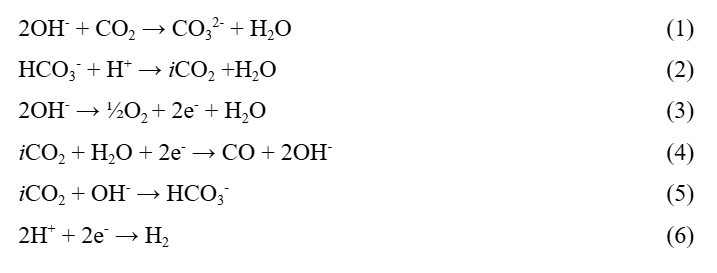
Reactive carbon capture, also known as “iCCC” and “combined CCR”, uses an electrolytic cell to generate acid and base. The base is used to capture CO2 in the form of CO32– (equation 1) and the acid is used to regenerate the CO2 inside the reactor at the cathode (iCO2, equation 2). Electrons from water oxidation at the anode are then used to drive iCO2 reduction at the cathode (equation 3; equation 4). RCC bypasses the most energy-intensive step of CCU—CO2 regeneration and compression—by generating the CO2 in-situ rather than using high temperatures or low pressure. Beyond decreasing energy utilization up to 44% (Siegel et al., 2022), it also offers several other advantages: (i) simplified electrolyzer design and operation; (ii) elimination of the most abundant impurity, O2 (15% in flue gasses; 21% in air), from the electrolyzer; (iii) >50% increase in CO2 utilization efficiency(Namdari et al., 2025); (iv) reduction of solvent regeneration costs by enabling electrolyte recycling (Kim et al., 2024); (v) costs below $1 per kg CO (Kim et al., 2025).
Reaction Mechanism and Electrolyzer Components
Reactive carbon capture electrolyzers can be constructed using a variety of configurations; however, high-efficiency systems share several key components, according to Namdari et al. (2025). Bipolar membranes (BPM) or Proton Exchange Membranes (PEM) are commonly employed to selectively deliver protons to the cathode compartment, where an acidic environment is required to generate the in-situ CO2 by releasing it from the capture agent (equation 1). By allowing both the cathode to be acidic and the anode to be basic, these membranes also suppress parasitic bicarbonate formation (equation 5), which otherwise reduces CO2 availability and lowers system efficiency. The electrolyte system typically consists of a basic KOH solution at the anode and an acidic H2CO3 or HCO3– solution at the cathode.
The overall reaction mechanism of reactive carbon capture is illustrated schematically in Figure 1, highlighting CO2 activation, proton transfer, and electrochemical reduction pathways within the electrolyzer.

Figure 1: The process through which reactive carbon capture electrolyzers generate and convert in-situ carbon dioxide. First, carbon dioxide is captured using base; then it is regenerated into in-situ CO2 (iCO2) using acid; finally, it is reduced into CO electrochemically using electrons from the OER. This figure was adapted from Namdari et al., 2025.
Challenges
Reactive carbon capture (RCC) systems face several interconnected challenges, with the most critical being the selectivity of CO2 reduction toward CO over the competing hydrogen evolution reaction (equation 6). In aqueous electrolytes, HER is often thermodynamically favored due to its less negative standard reduction potential, thus diverting electrons away from CO2 conversion and reducing Faradaic efficiency. This issue is amplified in RCC because CO2 is captured as carbonate (CO32-) and bicarbonate (HCO3–), which require proton-driven in situ CO2 regeneration (Lee et al., 2025). The National Renewable Energy Laboratory Golden, CO (2024) further notes that these selectivity challenges are compounded by catalyst degradation, flue gas impurities (e.g., SOₓ and NOₓ) that poison active sites, and broader concerns regarding durability, scalability, all of which must be addressed for efficient and practical RCC deployment. One area of research that can help mitigate the above challenges is electrode and catalyst design.
Electrodes and Catalysts
This research focuses on increasing the efficiency and selectivity of the CO2-to-CO conversion step by investigating the catalyst used at the cathode. Dickinson and Symes (2022) state that effective catalysts demonstrate high selectivity toward a desired product at low overpotentials, maintain long-term stability, and remain active over multiple catalytic cycles.
Transition metals are commonly employed as CO2 reduction catalysts due to the presence of catalytically active d-electrons and/or vacant orbitals that facilitate the adsorption and desorption of CO2 and key reaction intermediates. Metals are often selected based on their binding strength toward specific intermediates, as this determines reaction pathways and product selectivity. For instance, copper is one of the only monometallic catalysts known to produce multi-electron CO2 reduction products with an appreciable Faradaic efficiency; however, pure Cu suffers from limited activity and poor selectivity under many operating conditions (Dickinson and Symes, 2022). Silver and gold catalysts have also been found to be extremely selective for the electrochemical reduction of carbon dioxide into carbon monoxide, but require large overpotentials (Boutin and Haussener, 2024). Consequently, improved catalyst systems are required to enable efficient, scalable CO2 electroreduction.
Bimetallic Electrodes
One promising strategy for enhancing catalytic performance is the use of bimetallic catalysts. The incorporation of a second metal can modify electronic structure, stabilize key intermediates, and tune adsorption energies (Husile et al., 2025).
Recent studies have demonstrated that synergistic effects in bimetallic systems can significantly improve performance. For example, Ma et al. (2024) found that Ni–Co-based catalysts facilitate efficient electron transfer, while phosphide incorporation enhances intrinsic catalytic activity. NiCoP electrodes supported on flexible substrates have shown outstanding performance for hydrogen and oxygen evolution reactions, achieving low overpotentials of 43 mV and 164 mV, respectively. Additionally, Cu–Zn catalysts have shown a dramatic improvement of electrochemical CO2 reduction to methanol with a faradaic efficiency up to 94% (Stolar et al., 2021). These findings highlight the potential of bimetallic systems to outperform their monometallic counterparts through cooperative electronic and structural effects.
This research aims to investigate the faradaic efficiency of the CO2 → CO conversion step in a reactive carbon capture system by minimizing the competing hydrogen evolution reaction and maximizing CO selectivity using bimetallic cathode catalysts. Through experimentation, it was found that all bimetallics outperformed the monometallic catalysts by a significant margin, with Ni on Cu as the highest-performing formulation.
Materials
Bimetallic Catalyst Materials
Catalyst materials were selected based on their selectivity for CO and for their availability. Previous research shows that nickel, gold, silver, zinc, and copper-based catalysts all tend to catalyze CO2 to CO (Liao et al., 2025). Some other metal catalysts, including indium, mercury, and tin, tend to generate HCOO–/HCOOH. Alternatively, iron and platinum are more favourable towards the HER reaction instead of CO2 reduction (Husile et al., 2025). Therefore, the metals investigated in this study were bimetallic combinations of nickel, copper, silver, and zinc, all of which were obtained from the metal inventory of West Point Grey Academy (WPGA). Gold and silver were excluded due to their high cost and limited practical scalability. Four variations were conducted for each metal pair (metal A alone, metal B alone, metal A plated onto metal B, and metal B plated onto metal A), and each variation was repeated three times to reduce error.
An H-Cell was (50 mL pool compartments) purchased from the YPLZYANJIAO store on Amazon. NaHCO3 (Brand: Arm and Hammer) and KOH (1M; Brand SchoLAR Chemistry) were obtained from the WPGA chesmical supply. Copper wire (Brand: Cyrico Wire), silicon tubing (Brand: Tygon; S 50 HL Class VI; 1.5mm outer radius), wire cutters (Brand: WISS; Carbon Steel M3 Large), superglue (Brand: Lucomb), and a magnetic stirrer (Brand: Vernier) were obtained from the WPGA maker-materials supply. 3D printing was conducted with Thermoplastic Polyurethane (TPU) material on a Bambu Lab A1 3D printer. A 4x4cm bipolar membrane was obtained from the Fuel Cell Store. An analog MQ-7 electrochemical carbon monoxide sensor was purchased from Sparkfun Electronics.
Methods
Electrolyzer Construction
To investigate the hypothesis that bimetallic catalysts will be more effective at selectively producing CO during CO2 electroreduction than monometallic catalysts, a standard H-cell design was employed for these experiments (see Figure 2 below).

Figure 2: An orthographic sketch of the electrolyzer with front view (A), side view (B), and top view (C).
To make the compartments airtight, EPDM rubber tubing was cut in half, with the inside secured onto the rim of the compartment using superglue, acting as a seal. Electrodes were suspended in the 50mL chambers through 3D printed electrode holders and copper wire. The 3D printed electrode holders were cut to 2cm and were sanded to remove remaining 3D print supports; 5cm of copper wire was cut and inserted through the electrode holders so that 1cm of exposed copper wire remained at the bottom. Three plugs were also 3D printed for the three unused holes on the lid to maintain airtightness (See figure 3 below). The bipolar membrane was then inserted between the two cells with a clamp and two rubber gaskets to prevent leaks and rips.

Figure 3: OnShape designs of the 3D Printed electrode holder (left) and plug (right)
Electrode fabrication
Bimetallic cathodes were fabricated using electrodeposition. Metals were cut into 2cm × 2cm × 1.0mm slabs; a 1mm radius hole was made 5mm from the top of the slab by hammering a nail (size 3d) through the metal. One metal served as the base electrode, with the second metal being deposited on top. Prior to deposition, all base electrodes were cleaned by immersion in 0.1M HCl for 30 seconds to remove surface oxides, then rinsed with distilled water. The electrode that served as the base electrode was half-submerged in the solution.
Electrodeposition was conducted under constant current conditions. For all trials, the current was controlled at 0.5A, and deposition time was 2 minutes (1 minute on each side). The reduction half-reactions for each metal are listed below.

The total charge passed during deposition was calculated using equation 10:

The total number of electrons transferred was determined using equation 11:

The electrolyte concentration was 1M for all plating solutions (NiSO4, ZnSO4, CuSO4) to ensure consistent ion availability, and the solution was constantly stirred with a magnetic stirrer at gear 5.
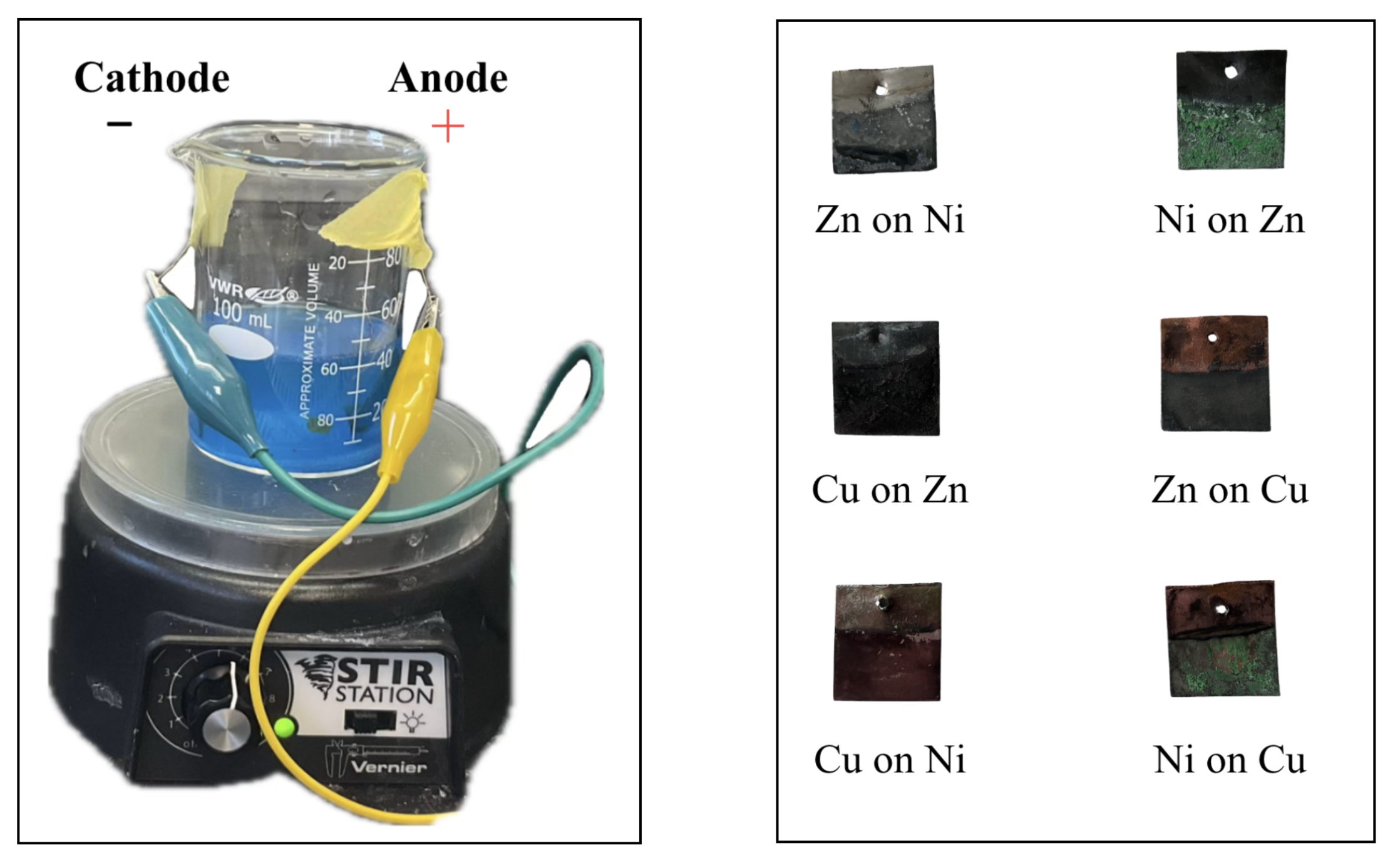
Figure 4: Electrodeposition setup for Copper on Zinc using CuSO4 (left). All plated electrodes (right).
Experimental Procedure
Each fabricated electrode was installed by suspending it at the end of a copper wire at the cathode compartment in the reactive carbon capture electrolyzer. The anode for all reactions was nickel. The anode and cathode chambers were filled with 30 mL 1.0 M KOH and 1.0 M NaHCO3, respectively. Electrodes were connected to the power supply such that the cathode was connected to the negative terminal and the anode to the positive terminal.
Electrolysis was conducted under constant current, with the current initially set to 0.1 A. Each trial was run for 10 minutes, during which the CO concentration was recorded every 10 seconds using the CO sensor–Arduino system in a separate compartment. This separate compartment consisted of a 200mL Erlenmeyer flask sealed with a size 5 stopper with two holes: one for the incoming silicon tubing and one for the wiring of the carbon monoxide detector.

Figure 5: Photo of experimental setup with labels.
Between trials, the electrolytes were replaced, and both chambers, electrodes, and the bipolar membrane were thoroughly rinsed with distilled water to prevent cross-contamination. When not in use, the bipolar membrane was stored in 1M KCl.
Data Analysis
A carbon monoxide analog sensor was used to measure the carbon monoxide output every 10 seconds for ten minutes. Silicon tubing linked the cathode compartment to a separate collection compartment where the carbon monoxide sensor was located. A sample program in Arduino derived from Sparkfun Electronics with slight edits for this measurement can be found in Listing 1.

Listing 1: Arduino code for CO detection; codes for the [CO] to be reported in ppm every 10 seconds.
The wiring diagram can also be found in Figure 6:
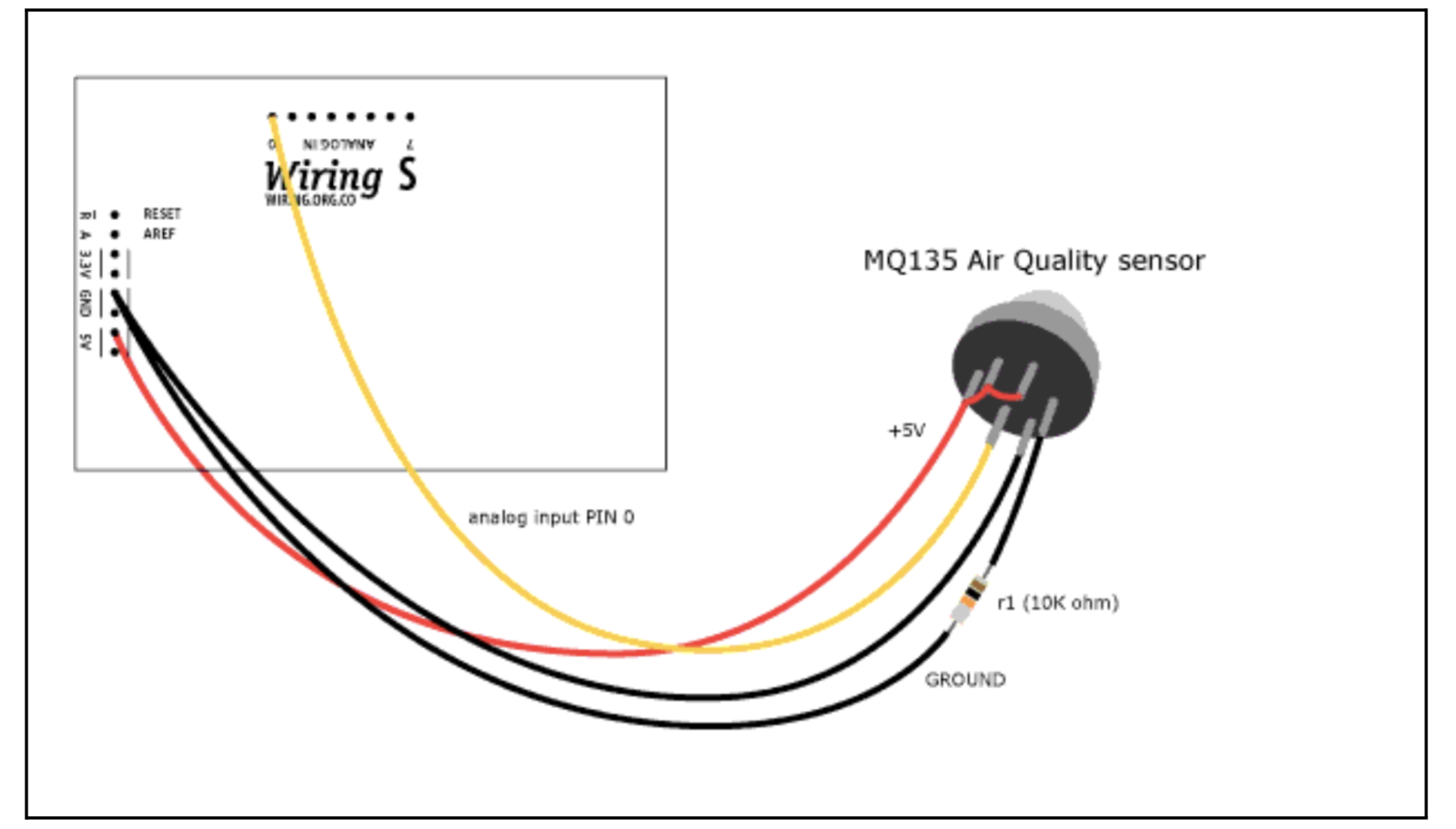
Figure 6: CO wiring diagram to Arduino derived from Hernando Barragán on Wiring.
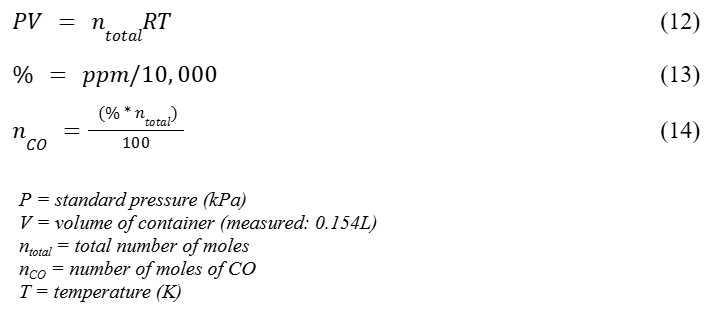
The final carbon monoxide parts per million (ppm) data point from each trial was then converted to moles using equations 12-14.
Data Interpretation
The efficiency of CO conversion was determined by calculating the faradaic efficiency of each metal combination using equation 15.

Data
Table 1: Changes in the concentration of CO for each catalyst ([CO]f – [CO]i)


Figure 7: [CO] in the collection chamber for each catalyst throughout 10 minutes with data points every 10 seconds.
Table 2: Faradaic efficiency for each catalyst as calculated using equations 12, 13, 14, 15.


Figure 8: Bar graph showing the faradaic efficiency of CO2 to CO conversion for each catalyst.
Analysis of Results
The data show differences in both total [CO] produced as well as the rate of [CO] produced. As shown in Figure 7, the Ni on Cu test (a) showed the most rapid increase in CO, while the Zn (f) and Ni on Zn (d) tests showed a more gradual, linear increase. The Zn (f) and Ni on Zn (d) tests were also the only tests that did not reach a steady state after ten minutes of testing. Overall, all bimetallic electrodes outperformed the monometallic electrodes in terms of faradaic efficiency of CO production, which is shown in the bar graph in Figure 8.
Nickel plated on copper showed the greatest improvement (230%) from its monometallic counterpart (copper), while zinc on copper followed closely at 217.91%. This trend suggests that copper, despite being the weakest monometallic performer, serves as a highly receptive base metal for catalytic enhancement when paired with a second metal. Conversely, nickel-based bimetallics showed more modest but still substantial improvements over monometallic nickel, with nickel on copper improving by 65.54% and nickel on zinc by 58.05%. This difference of faradaic efficiencies between base metal and coating points to the importance of which metal serves as the base versus the plated layer. The percentage performances of each catalyst combination is reported in Table 3:
Table 3: Percentage improvement of electroplated electrodes; calculated using (FEbimetallic – FEmonometallic ) / FEmonometallic

Monometallic Nickel’s Superior Performance: Sabatier Principle
My monometallic tests showed that nickel had the highest efficiency, followed by copper and zinc; these results can be explained by the Sabatier principle. The Sabatier principle states that an ideal catalyst binds reaction intermediates with an intermediate strength to minimize activation energy. According to Figure 9a, of the chosen monometallic metals, nickel places closer to the optimal CO2 adsorption and desorption energy than copper. By contrast, on Figure 9b, copper and zinc sit closer to optimal binding strength of CO than nickel. This discrepancy between the two diagrams can be associated with the tests for Figure 9a using “atomically dispersed metal sites on nitrogen-doped carbon”, meaning that the metal catalysts contained nitrogen atoms surrounding the metal catalyst; to obtain the data in Figure 9b, the metal catalysts were not heavily treated. The method of my experiments is more consistent with the experimental procedure of Figure 9b, but my data is consistent with the pattern shown in Figure 9a and inversely proportional to Figure 9b. Some reasons for these inconsistencies may be attributed to surface oxidation of electrodes and differences in surface area, which will be discussed further in the limitations section.
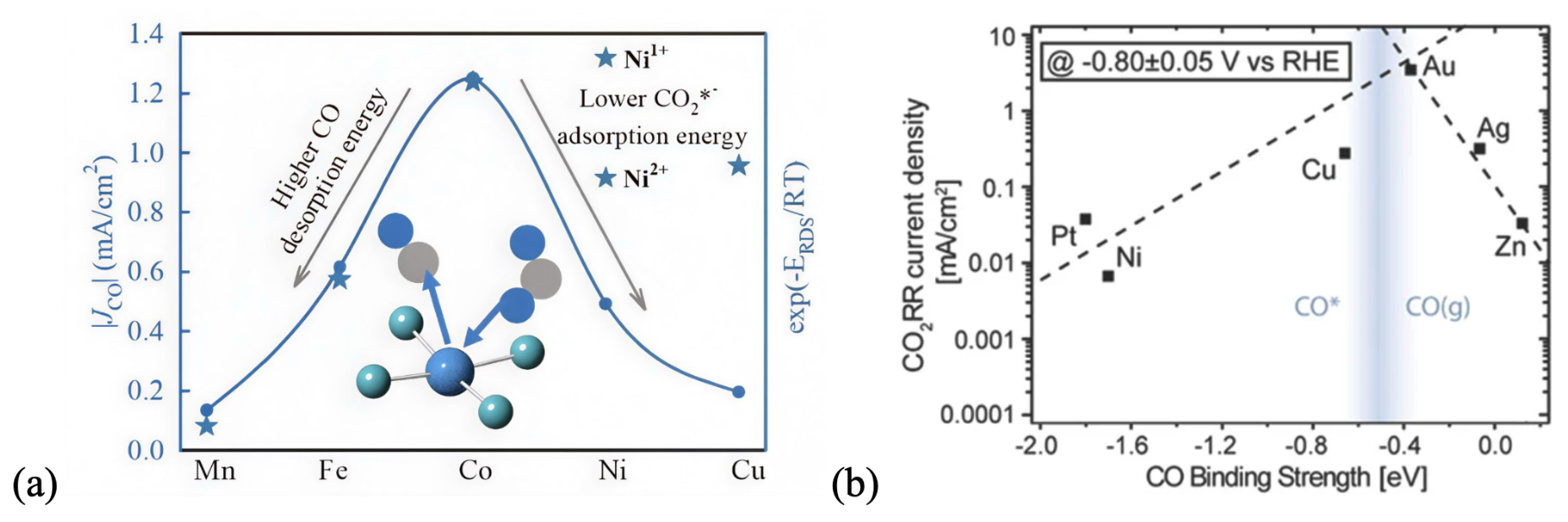
Figure 9: Previous studies examining metal catalyst performance for CO2 reduction into CO (a) the adsorption and desorption of energy of various metals treated with nitrogen-doped carbon adapted from Li et al., 2019. (b) the binding strength and current density of metal catalysts adapted from Ni and Wang, 2015.
Bimetallic Catalysts’ Superior Performance Over Monometallics: D-Band Theory
The superior performance of the bimetallic catalysts compared to monometallic catalysts can then be explained due to electron shell interactions that enhance CO2 activation and suppress HER. Specifically, catalyst behavior in bimetallic bonding can be explained by the d-Band Theory. In this theory, the binding strength between a metal catalyst and a reactant is determined by its d-band energy, Fermi level, and chemical potential. When two metals are brought into contact through electroplating, their d-orbitals overlap, and depending on the degree of that overlap, the d-band center of the surface metal shifts either toward or away from the Fermi level, which changes the chemical potential of the catalyst surface (Li et al., 2025). This new chemical potential can be made more favorable to binding a certain reactant, and thus increase catalytic activity, even when neither constituent metal is a good catalyst for that reactant.
This mechanism is particularly well illustrated by the nickel-on-copper system. When nickel is deposited onto copper, the chemical potential energy shifts. The result is a surface that more selectively stabilizes the *COOH intermediate necessary for CO2-to-CO conversion while simultaneously suppressing the competing hydrogen evolution reaction (HER) (Pengyuan, 2015). In my experiment, I observed that the nickel-on-copper catalyst demonstrated a 230% improvement compared to monometallic copper and a 66% improvement from monometallic nickel.
The zinc-containing bimetallics can be interpreted through a similar mechanism; zinc’s d-band is nearly fully filled and sits well below the Fermi level, meaning it does not have an optimal chemical potential energy for CO2 reduction—consistent with its observed poor monometallic performance. However, when paired with nickel or copper, zinc’s electronic structure shifts the d-band center into a more catalytically active metal for CO2. In the case of zinc-on-copper, this appears to push copper’s d-band center closer to the Fermi level, improving faradaic efficiency by 189.80% over monometallic zinc and 156.72% over monometallic copper (Mardones‐Herrera et al., 2025).
Limitations
While the amount of metal and area of the catalyst electroplated was controlled using constant current, time, and concentration, a possible error could have been the differing texture of the bimetallic electrodes: specifically, the nickel-plated electrodes were rougher than the copper and zinc-plated electrodes. This roughness could have contributed to an increase in electrode surface area. Increased surface area can enhance performance by providing more active sites for reactions, lowering overpotential, and increasing total electric current (Zhu and Zhao, 2017).
Moreover, faradaic efficiency is a good measure of how efficiently electrons in the current were used to generate the desired product, but it does not capture voltage differences between tests. Changes in cell voltage affect the electrochemical potential at an electrode surface, which significantly alters the fermi level of a metallic catalyst. Therefore, the observed catalytic trends could have resulted from a shift in electrode potential rather than catalytic properties.
Additionally, the testing duration may not have captured steady-state behavior for the Zn electrode and Ni on Zn electrode as those test values did not reach an asymptote at the end of the ten minutes.
Future Research
These limitations provide directions for future research. In my study, I was not able to quantitatively account for inconsistencies in catalyst surface area. To better understand surface area effects on catalytic activity in the future, the surface area of the bimetallic electrodes can be measured. Measurement techniques like electrochemical surface area (ECSA) or Brunauer-Emmett-Teller (BET) surface area determination (Yoon et al., 2017) can be used to gather this data. Then, the faradaic efficiency results could be normalized to the surface area by dividing faradiac efficiency by the surface area and obtaining the faradaic efficiency per cm2.
This study evaluated catalytic performance under constant current conditions, but it did not capture voltage effects on catalytic activity. Moreover, to account for the differences in voltage between trials as a result of constant current, electrochemical potential studies could be conducted on the binding of CO2 to catalyst surfaces. One technique that could be implemented is Cyclic Voltammetry (CV), where the potential at the electrode surface is controlled, and current responses are recorded.
Moreover, I controlled the amount of electrons passing through the electrolyzer by maintaining constant current and trial times; in the future, to ensure that a steady state is reached, the duration of all tests should be increased. Conducting more trials for each electrode variation would also reduce the experimental error.
Finally, to further gauge the potential of bimetallics in industrial settings, a future study could include comparing these bimetallic electrodes to more costly, standardized electrodes like silver, gold, and platinum.
Conclusion
This research highlights the potential of implementing bimetallic catalysts to increase the faradaic efficiency of CO2 to CO reduction in reactive carbon capture. With all bimetallic catalysts outperforming their monometallic counterparts, these results present a compelling case for more energy and cost efficient CO2 reduction in a reactive carbon electrolyzer. In the global effort to reduce carbon dioxide footprints, this provides industries with scalable and lower-cost carbon capture technologies, bringing electrochemical CO2 conversion closer to practical large-scale implementation.
References
Boutin, E., & Haussener, S. (2024). Rate-Determining Step for Electrochemical Reduction of Carbon Dioxide into Carbon Monoxide at Silver Electrodes. ACS Catalysis, 14(11), 8437–8445. https://doi.org/10.1021/ACSCATAL.4C00192
Dickinson, H. L. A., & Symes, M. D. (2022). Recent progress in CO2 reduction using bimetallic electrodes containing copper. Electrochemistry Communications, 135, 107212. https://doi.org/10.1016/J.ELECOM.2022.107212
Husile, A., Wang, Z., & Guan, J. (2025). Bimetallic effects in carbon dioxide electroreduction. Chemical Science, 16(13), 5413. https://doi.org/10.1039/D5SC00670H
Kim, Y., Lees, E. W., Donde, C., Jewlal, A. M. L., Waizenegger, C. E. B., de Hepcée, B. M. W., Simpson, G. L., Valji, A., & Berlinguette, C. P. (2024). Integrated CO2 capture and conversion to form syngas. Joule, 8(11), 3106–3125. https://doi.org/10.1016/j.joule.2024.10.010
Kim, Y., Namdari, M., Jewlal, A. M. L., Chen, Y., Pimlott, D. J. D., Stolar, M., & Berlinguette, C. P. (2024). Economic Viability of Integrated CO2 Capture and Conversion. ACS Energy Letters, 10(1), 403–409. https://doi.org/10.1021/ACSENERGYLETT.4C02852
Lee, T., Jeong, H. il, Cha, Y. A., Shin, D. H., & Nam, D. H. (2025). Advances in reactive carbon capture via carbonate/bicarbonate electrolysis for efficient CO2 utilization. Chemical Communications, 61(92), 18037–18052. https://doi.org/10.1039/D5CC04387E
Li, J., Pršlja, P., Shinagawa, T., Martín Fernández, A. J., Krumeich, F., Artyushkova, K., Atanassov, P., Zitolo, A., Zhou, Y., García-Muelas, R., López, N., Pérez-Ramírez, J., & Jaouen, F. (2019). Volcano Trend in Electrocatalytic CO2 Reduction Activity over Atomically Dispersed Metal Sites on Nitrogen-Doped Carbon. ACS Catalysis, 9(11), 10426–10439. https://doi.org/10.1021/ACSCATAL.9B02594
Li, K., Tao, Z., Ma, X., Wu, J., Wu, T., Guo, C., Qi, Y., Yu, J., Zheng, J., & Xue, J. (2025). The application and research progress of d-band center theory in the field of water electrolysis. International Journal of Hydrogen Energy, 132, 183–211. https://doi.org/10.1016/j.ijhydene.2025.02.305
Namdari, M., Kim, Y., Pimlott, D. J. D., Jewlal, A. M. L., & Berlinguette, C. P. (2025). Reactive carbon capture using electrochemical reactors. Chemical Society Reviews, 54(2), 590–600. https://doi.org/10.1039/D4CS00834K
Ozkan, M. (2024). Atmospheric alchemy: The energy and cost dynamics of direct air carbon capture. MRS Energy & Sustainability 2024 12:1, 12(1), 46–61. https://doi.org/10.1557/S43581-024-00091-5
Papp, H., & Baerns, M. (1991). Chapter 10 Industrial Application of Co Chemistry for The Production of Specialty Chemicals. Studies in Surface Science and Catalysis, 64(C), 430–461. https://doi.org/10.1016/S0167-2991(08)60952-0
Pengcheng Zhu, & Yuyuan Zhao. (2017, April 12). Effects of electrochemical reaction and surface morphology on electroactive surface area of porous copper manufactured by Lost Carbonate Sintering – RSC Advances (RSC Publishing) DOI:10.1039/C7RA04204C. https://pubs.rsc.org/en/content/articlehtml/2017/ra/c7ra04204c
REACTIVE CARBON CAPTURE PROJECT REVIEW MEETING NATIONAL RENEWABLE ENERGY LABORATORY GOLDEN, CO. (n.d.).
Siegel, R. E., Pattanayak, S., & Berben, L. A. (2022). Reactive Capture of CO2: Opportunities and Challenges. ACS Catalysis, 13(1), 766–784. https://doi.org/10.1021/ACSCATAL.2C05019
Stolar, T., Prašnikar, A., Martinez, V., Karadeniz, B., Bjelić, A., Mali, G., Friščić, T., Likozar, B., & Užarević, K. (2021). Scalable Mechanochemical Amorphization of Bimetallic Cu−Zn MOF-74 Catalyst for Selective CO2 Reduction Reaction to Methanol. ACS Applied Materials & Interfaces, 13(2), 3070–3077. https://doi.org/10.1021/ACSAMI.0C21265
Zheng, P., Zheng, Pengyuan, Zheng, & Pengyuan. (2015). Electron Scattering at Surfaces and Interfaces of Transition Metals. PhDT. https://ui.adsabs.harvard.edu/abs/2015PhDT……..99Z/abstract