Aarav Sharma — Year 2, Applied Science
Abstract:
High relative humidity in school lockers, specifically in the temperate rainforest climate of Metro Vancouver, creates an ideal environment for mold growth, posing health and hygiene risks to students. This project addresses the lack of portable ventilation solutions for small locker compartments with no live power. While commercial solutions like silica gel packets are common, they are passive, not reusable, and fail to address the root cause, which is stagnant air. This “Smart Locker Ventilation” prototype was developed using an UNO R3 Controller Board (Arduino), a B1 Power Bank (Guangdong Aoyun Technology Co.) , a DHT11 sensor (Adafruit), a 5V RGB fan, transistor, and activated carbon pads. In a five-day controlled study, the system reduced high moisture events from 120 hours to just 14 hours. While the control environment exhibited visible fungal colonization and a pungent smell by Day 5, the experimental environment remained dry and odorless. This prototype provides a portable and compact engineering solution to improve school hygiene and personal property maintenance.
Introduction:
Mold growth in enclosed indoor spaces is a significant environmental concern, as fungal species thrive in environments with elevated humidity, stagnant air, darkness, and organic material (Palaty, 2010). Metro Vancouver’s temperate rainforest climate provides an ideal environment for this growth due to frequent humidity spikes and high annual rainfall (Health Canada, 2007). In local secondary schools, densely packed metal lockers are frequently used to store damp clothing and athletic gear, creating high risk environments for fungal colonization.
While moisture control research is extensive, most existing technologies are designed for large scale residential use. For example, modern ventilation systems utilize integrated sensors to adjust airflow based on live CO2 and moisture levels to maintain Indoor Air Quality (IAQ) (Rashid et al., 2025). However, these systems require hard wired electrical power and external venting, which are impossible to implement in a standard school locker (Guyot et al., 2017). Current portable alternatives that can be used, such as battery powered mini dehumidifiers, are impractical for micro environments like school lockers due to high power consumption, which would quickly deplete a standard power bank, and a lack of odor filtration. On top of this most “mini” air de humidifiers are far from mini, and would take up too much space in the average school locker.
Previous designs for small space moisture control, such as affordable passive silica gel packets, address moisture through absorption but fail to address stagnant air and the pungent smell that comes with mold. Silica gel packets are also usually for extremely small environments like an amazon package, and cannot control a locker. With air de humidifiers being too large for a locker, and silica gel packets being too small, I had to make a gadget that could be in the goldilocks zone for lockers. This prototype bridges the gap by miniaturizing active HVAC (Heating, Ventilation, and Air Conditioning) principles. It utilizes a combination of mechanical exhaustion to move air, a DHT11 sensor to monitor temperature and dew point, and activated carbon media to remove Volatile Organic Compounds (VOCs) and odors. By applying established ventilation theory, specifically mechanical exhaustion, this project seeks to protect student health, hygiene, and personal property through a specifically built, portable, and battery powered system.
Materials and Methods:
The prototype was constructed using an UNO R3 Controller Board (Arduino) as the central logic unit. To monitor the environment, a DHT11 sensor (Adafruit) was utilized to provide real time humidity and temperature feedback. Mechanical ventilation was managed by a 5V USB RGB gaming fan, which was triggered by the microcontroller through a PN2222 NPN Transistor configured as a high-side switch. To address air quality and odors, an activated carbon sheet the exact size of the fan was attached to serve as a passive media filter. To power all of this, a B1 Power Bank (Guangdong Aoyun Technology Co.) was used. The electronics, including the UNO R3 and transistor circuitry, were housed inside a modified cardboard wireless earbud package that served as a protective cage. The DHT11 sensor was mounted externally on top of the enclosure to isolate it from internal heat generated by the board and direct airflow from the fan, ensuring more accurate ambient readings. The fan with the attached carbon pad was mounted to the front, and the power bank was attached to the back.
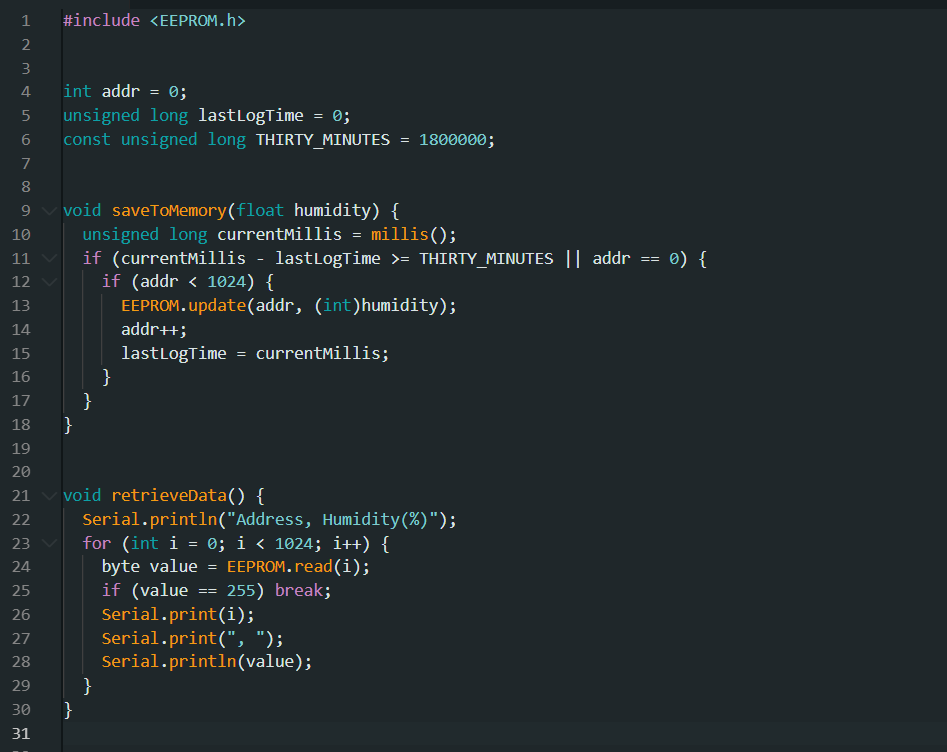
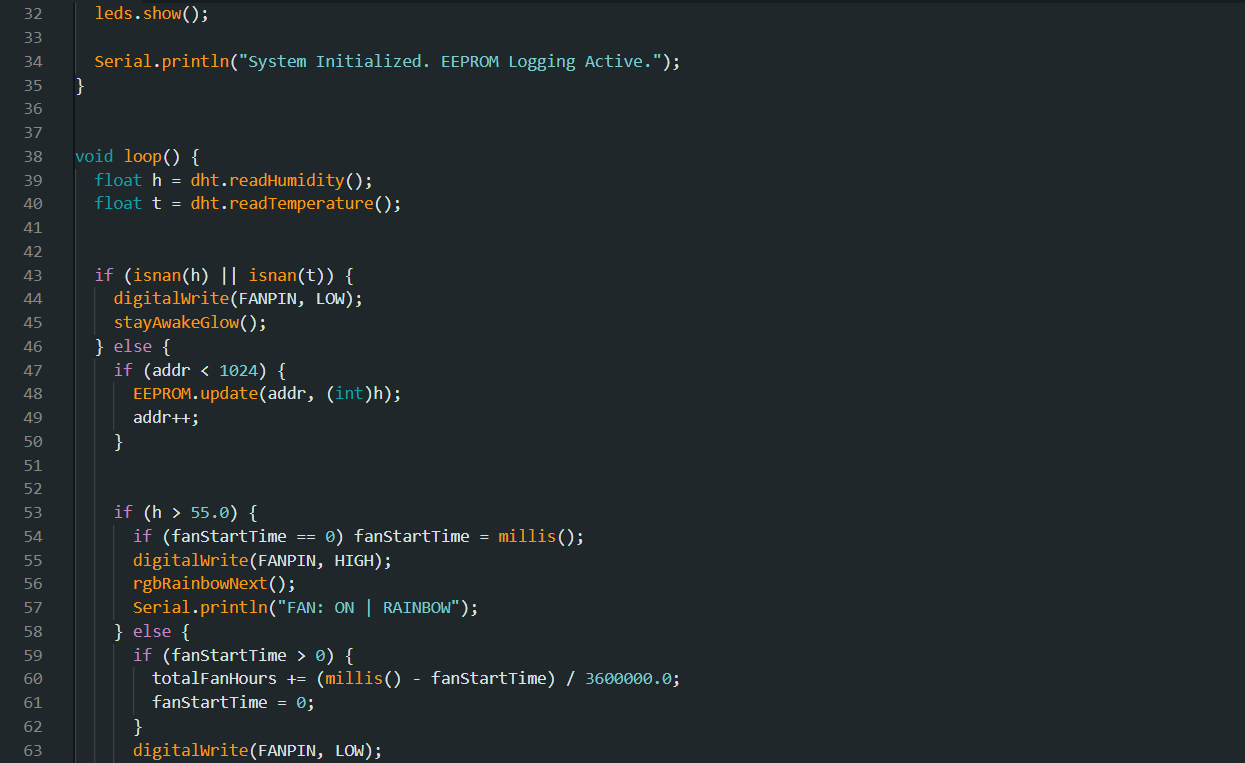
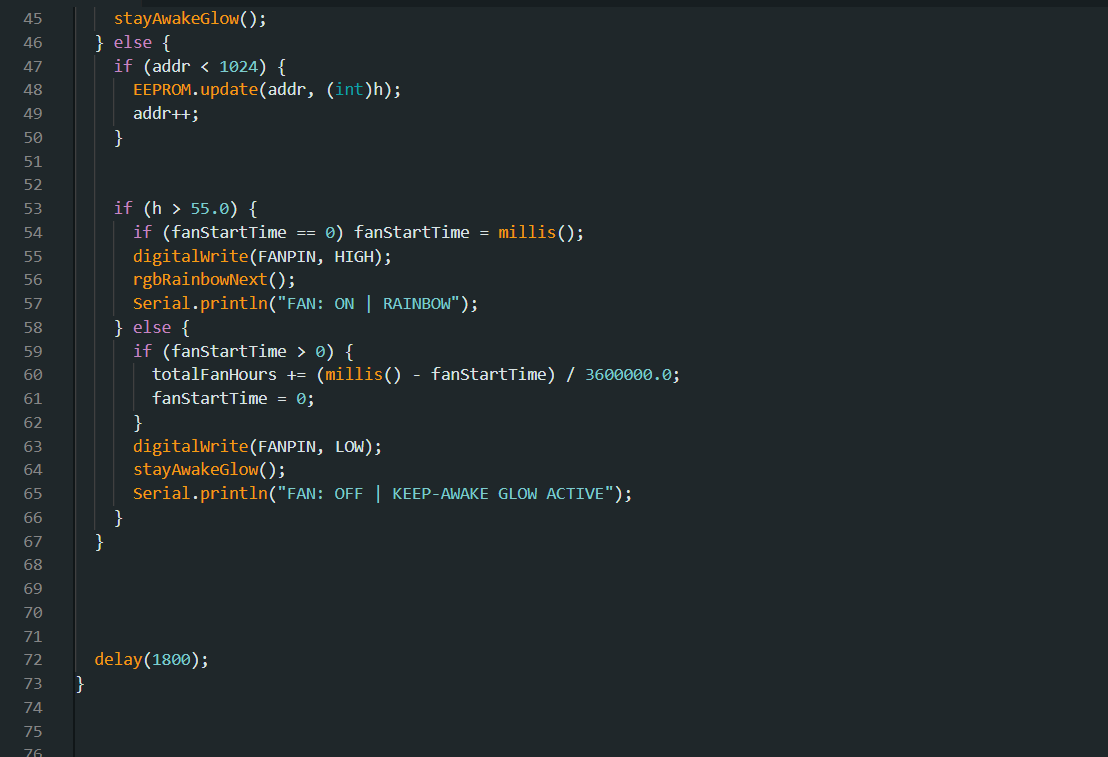
The system logic was programmed in C++ using the Arduino IDE application to poll the sensor every second. If relative humidity exceeded 55%, the controller activated the fan and a rainbow LED sequence to signal active ventilation. To prevent the 5000mAh USB power bank from automatically cutting off due to the low current draw of the idle microprocessor, a custom stayAwakeGlow() function was implemented. This function maintained a constant electricity draw through a dim flickering white baseline light and periodic bright white pulses. Another code was created that can be attached to the main code. It uses EEPROM (Electrically Erasable Programmable Read Only Memory) to track all the readings that were done during the runtime of the gadget. It saves all the readings in the micro controllers storage, which is not a lot, but due to the readings just being text, around 20 days of readings could be saved with the Uno R3 Microcontroller specifically. The data is recorded in chronological order from the time the microcontroller was turned on, and saves data every thirty minutes (Code is provided in appendix).
Testing was conducted over 120 hours using two 19 liter black plastic containers modified with ventilation slits to simulate a school locker. To simulate real world moisture loading, a damp cotton T shirt was added on Day 1, followed by damp socks (1 in each box) on Day 2. On Day 4, a slice of white bread was introduced as a biological indicator. This method is an established practice in environmental microbiology used to verify if an environment can support fungal life, as the high sugar and moisture content of bread makes it highly prone to rapid fungal colonization in short periods of time (Brambilla et al., 2022). By day 5, final observations were recorded, and everything was removed, terminating the experiment.
Results:
Upon the introduction of the damp garments on Day 1, an immediate humidity spike of 78% RH was recorded in the experimental environment (Container A), while the control environment (Container B) reached similar estimated humidity. By the conclusion of Day 1, Container A had already returned to the safe threshold of 52% RH due to the active ventilation system, and the shirt was quite dry to the touch, whereas Container B remained stagnant and damp. By Day 3, significant differences in air quality were observed, Container B exhibited heavy condensation on the interior lid and a noticeable musty odor, while Container A remained clear with neutral air quality. By the end of day 3 Container A had balanced out at around 49% and the former damp sock was dry to the touch. By Day 5, the contrast in biological state was blatant. The bread in the control box (Container B) exhibited advanced fungal colonization, likely Rhizopus stolonifer, characterized by five distinct, fuzzy white colonies (8–12 mm) with dark centers. This mold caused the bread to lose structural integrity and become floppy. Conversely, the biological indicator in the experimental box (Container A) remained entirely clear of visible mold, at a stable 47% humidity, and the stored materials were dry to the touch. Over the 120 hour study, the automated system recorded a cumulative active runtime of 14 hours to maintain an environment where no mold can be grown.
Table 1: Five Day Environmental Comparison
| Variable | Container A (Containing Anti Mold System) | Container B (Control) |
| Total Fan Runtime | 14 Hours (Cumulative) | 0 Hours |
| Peak Humidity | 78% (Recorded) | ~80-85% (Estimated) |
| Condensation (Day 3) | None | Observed (Lid) |
| Biological State (Day 5) | No Visible Mold | 8-12mm Fungal Colonies |
| Odor Profile | Neutral | Severe / Musty |
Discussion:
The results demonstrate that sensor triggered active ventilation significantly accelerates moisture evaporation in micro environments. By maintaining humidity levels below the 55% safety threshold, the prototype successfully prevented the conditions required for fungal colonization. A key finding was the efficiency of the targeted ventilation approach, the system only activated when moisture loads were high, ensuring the environment was stabilized before the biological indicator was introduced.
The primary engineering challenge was the power bank’s auto shutoff feature, which was successfully mitigated by the pulsing RGB idle logic. While this maintained system uptime for the full 120 hours, however it resulted in a ~15% final battery level. Future iterations could investigate more energy efficient idle possibly using a power bank with no cutoff, or the use of a second sensor in the control box to provide even more precise comparative data. Future studies could also use a better humidity sensor, since the DHT11 is budget and can make mistakes. Overall, this project proves that a low cost, sensor triggered system can effectively transform a school locker into a managed and hygienic environment.
References:
“A Brief Guide to Mold, Moisture, and Your Home.” United States Environmental Protection Agency, 25 Oct. 2023, www.epa.gov/mold.
“DHT11, DHT22 and AM2302 Sensors.” Adafruit Learning System, Adafruit Industries, 2024, learn.adafruit.com/dht.
Lstiburek, Joseph. “Moisture Control for Buildings.” Building Science Corporation, Apr. 2002, buildingscience.com/sites/default/files/migrate/pdf/PA_Moisture_Control_ASHRAE_Lstiburek.pdf.
Brambilla, A., Capelli, L., & Sironi, S. (2022). Indoor air quality and early detection of mould growth. UCL Open: Environment. https://pmc.ncbi.nlm.nih.gov/articles/PMC10171410/
Guyot, G., Sherman, M. H., & Walker, I. S. (2017). Smart ventilation energy and indoor air quality performance in residential buildings: A review. Lawrence Berkeley National Laboratory. https://eta-publications.lbl.gov/sites/default/files/smart_ventilation_energy_and_indoor_air_quality_performance_in_residential_buildings_a_review.pdf
Health Canada. (2007). Residential indoor air quality guideline: Moulds. Government of Canada. https://www.canada.ca/content/dam/canada/health-canada/migration/healthy-canadians/publications/healthy-living-vie-saine/mould-moisissure/alt/mould-moisissures-eng.pdf
Lstiburek, J. (n.d.). Moisture control for buildings. Building Science Corporation. https://buildingscience.com/sites/default/files/migrate/pdf/PA_Moisture_Control_ASHRAE_Lstiburek.pdf
Lyu, Z. (2023). An assessment of the influencing factors promoting the development of mould in buildings: A literature review. University College London. https://discovery.ucl.ac.uk/10204492/1/An%20Assessment%20of%20the%20Influencing%20Factors%20Promoting%20the%20Development%20of%20Mould%20in%20Buildings%2C%20A%20Literature%20Review.pdf
Palaty, C. (2010). Mould assessment in indoor environments. National Collaborating Centre for Environmental Health. https://ncceh.ca/sites/default/files/Mould_Assessment_May_2010.pdf
Rashid, F. L., Al Obaidi, M. A., Ameen, A., & Kezzar, M. (2025). Mechanical ventilation strategies in buildings: A comprehensive review of climate management, indoor air quality, and energy efficiency. Buildings, 15(14), 2579. https://www.mdpi.com/2075-5309/15/14/2579
Appendix
Code 1:
This code is the main program for the automated locker ventilation system. It utilizes the DHT11 sensor to monitor humidity and temperature levels, triggering the RGB fan and a visual LED “Rainbow” status alert whenever a 55% threshold is crossed. It also keeps the RGB fan in its idle flickering mode to ensure the power bank does not turn off.

Code 2:
This logic utilizes the internal EEPROM (Electrically Erasable Programmable Read Only Memory) to create a data log without external hardware. The EEPROM.update() function stores the humidity as a 1 byte integer at a specific memory address, which remains saved even when the Arduino is powered down. Due to the system lacking a real-time clock, it uses chronological indexing, the data is output as a list where each address represents a fixed 30 minute interval, allowing the user to reconstruct a full five day timeline by mapping the starting address to the initial time of the experiment.