Niharika Yadav — Year 2, Life Science
Abstract
This study evaluated the stacking potential and efficiency of Ocimum basilicum-grown plant microbial fuel cells (PMFCs) under series and parallel configurations. Ten PMFCs were constructed using identical soil and basil plants. Voltage outputs were measured across increasing numbers of PMFCs in both configurations. In the series circuit, voltage increased from 0.372 V (2 PMFCs) to 0.610 V (6 PMFCs). The increase was not perfectly linear due to internal resistance, as well as biological variability between cells. In contrast, the parallel configuration produced relatively constant voltages ranging from 0.291 V to 0.322 V, indicating that voltage does not scale with additional PMFCs in parallel systems. These results highlight that series stacking is more effective for increasing voltage, while parallel configurations provide stability but limited voltage gain. Future research could explore the effects of different plant species, improved environmental control, and long-term voltage monitoring to further enhance the performance and practical applications of PMFC systems.
Introduction
Rapid economic growth has led the world to increase the use of fossil fuels, but this has severe environmental impacts (Paramati et al.,2022). These environmental impacts include global warming and air pollution, both of which cause many health problems such as respiratory issues and infectious diseases (Martins et al.,2019). Due to this issue, intensive studies are being conducted to investigate and develop clean fuel technologies otherwise known as renewable energy (Ellabban et al., 2014; Kumar et al.,2021).
One promising source of renewable energy is the plant microbial fuel cell (PMFC). Essentially, a PMFC converts solar energy into bioelectricity through the metabolic activity of microbes at the rhizosphere region of a plant (Nitisoravut & Regmi 2017; Shaikh et al., 2020). The rhizosphere region of a plant is 2.00 mm from the root surface, and it affects the growth of plants while overseeing the plant’s nutrient intake (Dotaniya & Meena 2015).
The plant root produces and excretes a variety of rhizodeposits which include sugars, organic acids, polymeric carbohydrates, enzymes, dead cell materials, ethylene and CO2 (Bais et al., 2006; Uren 2000). Microbes at the rhizosphere region break down these rhizodeposits, specifically carbon in the anode region, to produce electrons (Nitisoravut & Regmi 2017; Strik et al.,2008). In a PMFC, the anode is located in the soil near the plant roots where microbial activity is the highest. The electrons that it produces then pass through to eventually reach the cathode (Strik et al.,2008). This separation creates a potential difference that drives the movement of electrons, thus producing a form of electricity known as bioelectricity (Strik et al.,2008).
There are various factors that affect the voltage performance of a PMFC. The type of plant and its health are vital for a long term performing PMFC. The plant must have a healthy growth rate of about 0.80 mm per day along with a healthy root growth rate, as this affects the area of the rhizosphere and bacteria type which is produced (Chong et al.,2025). In 2025, Chong et al., stated one of the main factors affecting a PMFC would be the rate at which the plant photosynthesizes, as it affects the plant’s ability to produce organic matter from its roots. The plants that best meet these conditions are C3 and C4 plants as these plants have different biochemical pathways used to absorb carbon during photosynthesis (Chong et al.,2025). Examples of C3 plants include barley, oats, rice and wheat, and C4 plants such as corn, sugarcane, and switchgrass (Chong et al.,2025; Fernie and Bauwe 2020).
Additional factors affecting a PMFC include environmental factors such as soil moisture, temperature, and pH (Chong et al.,2025). Soil moisture is essential to the metabolism of microbes as moisture improves the rhizosphere microbial structure directly affecting the plant growth and metabolic activity (Liu et al.,2022). Temperature also plays a role in the metabolic rate of microbes as higher temperatures increase the rate of microbial activity, thus increasing voltage production (Erensoy and Çek 2018). However, it is crucial to understand that higher temperatures that are very extreme can destroy the plant overall, so it is important that the plant remain at a moderate temperature (Xu et al., 2017). Additionally, the pH of the soil is another factor as microbes have optimal growth in a specific range (Chong et al.,2025). Maintaining an ideal pH range for the PMFC ensures the metabolic rate of microbes is maximised allowing efficient electron passage (Ulrich et al., 2019). Ensuring that the soil moisture, temperature and pH of a PMFC is within a recommended range allows for maximum voltage production.
There are many limitations that occur with a PMFC such as low voltage and lack of a steady voltage production along with a short lifespan of a plant which makes it difficult to apply a PMFC for practical use (Aftab et al., 2020). The purpose of this multi-phase study is to explore how various PMFC configurations affect the total voltage produced.
Materials and Methodology
Constructing PMFCs
Ten plant-microbial fuel cells (PMFC) were constructed by placing three centimetres of soil into ten identical containers. Ten six centimetres by six-centimetre square aluminium plates were placed on top of the two centimetres of soil to become the anode. Three centimetres of soil was placed over the anode and then an additional aluminium plate was placed on top to become the cathode. Three centimetres of soil was placed over the cathode, and a twelve-centimetre-tall basil plant was placed along with soil to fill the pot. The ten PMFCs were allowed to stabilize for five days. In these five days, the basil plants were kept at approximately 20 degrees Celsius, were given 50mL of water daily and were provided with eight hours of natural sunlight daily. The PMFCs were then connected in different circuit configurations such as series and parallel with variation in the number of PMFCs used in each trial.
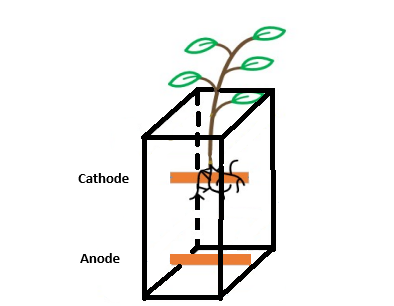
Figure 1: Diagram of Constructed PMFC
Series Configuration
When developing the series configurations, six separate circuits were created, each utilising a different number of PMFCs. The first series circuit trial consisted of two PMFCs connected by attaching the cathode of one PMFC to the anode of the second using jumper wires. The second trial consisted of three PMFCs connected by attaching the cathode of the first PMFC to the anode of the second PMFC and the cathode of the second PMFC was attached to the anode of the third PMFC. The third, fourth, fifth and sixth trials followed the same manner and the number of connected PMFCs increased by one in each subsequent trial. The total voltage for each series circuit was measured by connecting a Roadoor multimeter’s probes to the first PMFCs anode and the last PMFCs cathode. The voltage output was monitored and recorded for each series circuit and compared to observe how increasing the number of PMFCs in a series circuit affected the voltage output.
Parallel Configuration
Six separate parallel circuits were constructed with a varying amount of PMFCs. The first trial consisted of two PMFCs connected by attaching the anodes together and all the cathodes together. The total voltage of the parallel circuit was monitored and recorded by connecting a multimeter probe to one of the anodes and one to the cathode. The second, third, fourth, fifth, and sixth followed the exact same method and the number of connected PMFCs increased by one in each trial.
Results
Table 1: PMFC Voltage Reading in Series Configuration

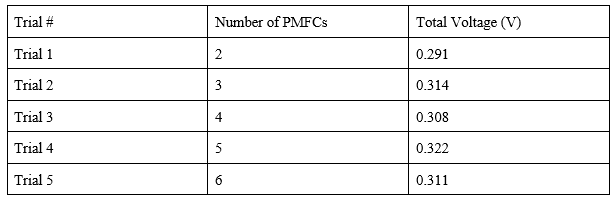
Table 2: PMFC Voltage Reading in Parallel Configuration
This study investigated how stacking multiple PMFCs in a series circuit affected the voltage produced. The voltage output of different PMFC configurations was measured and compared to determine the effect of increasing the number of PMFCs in the stack.
The results suggest that the voltage performance of a PMFC can be affected when individual PMFCs are stacked. As seen in Table 1, the series circuit, an increase in voltage was observed as the number of PMFCs increased. This is due to the principles of series circuits where the total voltage is equal to the sum of the voltages produced by each PMFC. Every PMFC produces a voltage and when connected, these voltages combine to produce a higher overall voltage. However, the increase in voltage was not directly proportional with the increase in PMFCs as it did not increase linearly.
As seen in Table 2, the voltage performance of a PMFC can be affected when individual PMFCs are stacked in a parallel circuit. In the parallel circuits, the voltage remained relatively similar as the number of PMFCs increase. This shows that adding additional PMFCs in a parallel circuit did not result in a substantial increase in voltage output.
Discussion
There are still limiting factors within a PMFC system that prevent an ideal performance. One major factor that contributes to this limitation is the internal and ohmic resistance within each PMFC. Each PMFC contains soil with microbial communities which, to an extent, resist the flow of electrons. When multiple PMFCs are connected in a series circuit, the voltages do increase but so does the resistance so it can reduce the total voltage across the circuit.
The parallel circuits produced voltage outputs that were relatively the same regardless of the number of PMFCs connected. This is due to how voltage behaves in parallel circuits. Since each PMFC is connected across the same two points, the overall voltage is the same throughout as if there was only one PMFC.
In order to ensure the accuracy and reliability of the results, several improvements could be made. In this study, each individual cell had variability in moisture level, microbial activity and root development. These natural variabilities meant that these factors were not fully controlled, which could have influenced voltage output and contributed to inconsistencies between trials. In the future, more controlled environmental conditions such as measuring the soil moisture, ensuring the plants are at equal growth stages and consistent electrode placement could help reduce the variability between the PMFCs. Additionally, this experiment could be expanded by utilizing more precise measurement tools such as a data logger for continuous voltage tracking over time rather than single-point readings. This would provide a more detailed analysis of how PMFCs outputs change throughout the day as they are exposed to different environmental conditions. Another improvement that could be made is using C3 and C4 plants that have higher photosynthetic rates which could increases microbial activity in the rhizosphere and lead to a greater voltage output.
For future applications, PMFCs have the potential to power energy systems which require less voltage. For example, they could be used to power environmental sensors in agricultural fields or wetlands. Additionally, they could be utilized in monitoring soil health and microbial activity as the voltage output can serve as an indicator of the biological processes occurring in the soil. Overall, this study demonstrated that the configuration of PMFCs influences the voltage output. As research into renewable energy continues, PMFCs may provide a sustainable source of bioelectricity for low-power applications, although further improvements are needed to increase their efficiency for practical use.
References
Paramati, S. R., Shahzad, U., & Doğan, B. (2022). The role of environmental technology for energy demand and energy efficiency: Evidence from OECD countries. Renewable and Sustainable Energy Reviews, 153, 111735.
Kumar, S., Saeed, G., Zhu, L., Hui, K. N., Kim, N. H., & Lee, J. H. (2021). 0D to 3D carbon-based networks combined with pseudocapacitive electrode material for high energy density supercapacitor: A review. Chemical Engineering Journal, 403, 126352.
Ellabban, O., Abu-Rub, H., & Blaabjerg, F. (2014). Renewable energy resources: Current status, future prospects and their enabling technology. Renewable and sustainable energy reviews, 39, 748-764.
Nitisoravut, R., & Regmi, R. (2017). Plant microbial fuel cells: A promising biosystems engineering. Renewable and Sustainable Energy Reviews, 76, 81-89.
Shaikh, R., Rizvi, A., Quraishi, M., Pandit, S., Mathuriya, A.S., Gupta, P.K., Singh, J., Prasad, R., 2020. Bioelectricity production using plant-microbial fuel cell: Present state of art. S. Afr. J. Bot.
Uren, N. C. (2000). Types, amounts, and possible functions of compounds released into the rhizosphere by soil-grown plants. In The rhizosphere (pp. 35-56). CRC press.
Bais, H. P., Weir, T. L., Perry, L. G., Gilroy, S., & Vivanco, J. M. (2006). The role of root exudates in rhizosphere interactions with plants and other organisms. Annu. Rev. Plant Biol., 57(1), 233-266.
Strik, D. P., Hamelers, H. V. M., Snel, J. F., & Buisman, C. J. (2008). Green electricity production with living plants and bacteria in a fuel cell. International journal of energy research, 32(9), 870-876.
Chong, P. L., Chuah, J. H., Chow, C. O., & Ng, P. K. (2025). Plant microbial fuel cells: A comprehensive review of influential factors, innovative configurations, diverse applications, persistent challenges, and promising prospects. International Journal of Green Energy, 22(3), 599-648.
Fernie, A. R., & Bauwe, H. (2020). Wasteful, essential, evolutionary stepping stone? The multiple personalities of the photorespiratory pathway. The Plant Journal, 102(4), 666-677.
Liu, D., Wang, Z., Zhu, G., Zhang, R., Bryant, R., Drohan, P. J., … & Xu, A. (2022). Stable soil moisture altered the rhizosphere microbial community structure via affecting their host plant.
Erensoy, A., & Çek, N. (2018). Alternative biofuel materials for microbial fuel cells from poplar wood. ChemistrySelect, 3(40), 11251-11257.
Xu, P., Xiao, E. R., Xu, D., Zhou, Y., He, F., Liu, B. Y., … & Wu, Z. B. (2017). Internal nitrogen removal from sediments by the hybrid system of microbial fuel cells and submerged aquatic plants. PloS one, 12(2), e0172757.
Ulrich, D. E., Sevanto, S., Ryan, M., Albright, M. B., Johansen, R. B., & Dunbar, J. M. (2019). Plant-microbe interactions before drought influence plant physiological responses to subsequent severe drought. Scientific reports, 9(1), 249.
Aftab, S., Shah, A., Nisar, J., Ashiq, M. N., Akhter, M. S., & Shah, A. H. (2020). Marketability prospects of microbial fuel cells for sustainable energy generation. Energy & Fuels, 34(8), 9108-9136.
Martins, F., Felgueiras, C., Smitkova, M., & Caetano, N. (2019). Analysis of Fossil Fuel Energy Consumption and Environmental Impacts in European Countries. Energies, 12(6), 964.
Dotaniya, M. L., & Meena, V. D. (2015). Rhizosphere effect on nutrient availability in soil and its uptake by plants: a review. Proceedings of the National Academy of Sciences, India Section B: Biological Sciences, 85(1), 1-12.