Angela Kim Mallette — Year 2, Life Science
Abstract
In recent years, an interest in fungi has been on the rise as people have increasingly noticed its medicinal potential, including antibacterial, anti-inflammatory, and antiproliferative properties. The Reishi mushroom has been one of the most widely researched species due to its bioactive compounds such as polysaccharides and triterpenoids. Referred to as the “mushroom of immortality” in traditional medicine, scientists have begun to investigate its ability to serve as an antiproliferative agent and immune system booster. However, its effects in the context of topical application have not been thoroughly investigated. This gap highlights the need for further research into its potential applications in topical treatments specifically.
Introduction
The existence of antimicrobial-resistant (AMR) infections presents a growing threat to global health, especially in immunocompromised individuals in rural and underserved communities (Ayukekbong et al., 2017). Poor hygiene, limited health infrastructure, and access to proper sanitation are just three factors contributing to the large percentage of deaths from common diseases in developing countries. A significant challenge lies in the limited financial investment that larger pharmaceutical companies put into antimicrobial research. This is largely because antimicrobial research often yields lower financial returns and is often deprioritized in favor of sustainable income, such as narcotics and drugs used to improve lifestyle. Transmission of harmful pathogens, however, is an ongoing and unavoidable public health concern that demands treatment, especially preventative measures. Some communities have even begun to look towards traditional healing practices as their first line of defense. In some cases, blind reliance on introducing unknown substances may result in ineffective treatment, allowing infections to linger and strengthening the pathogen’s development of resistance. Furthermore, neglecting the rising threat of AMR may result in various pathological consequences, ranging from mild to severe cases of refractory skin infections. For example, the well-known bacterium Staphylococcus aureus (S. aureus) is considered to be the most common
pathogen involved in skin infections worldwide, regardless of the patient’s age, the climate, or geographical area (del Guidice, 2020). Treatment for the buildup of abscesses and erosive plaques on the skin caused by S. aureus mainly involves solutions of topical prescriptions, such as fusidic acid and neomycin. However, these topically applied antibacterial agents introduce the risk of allergies, renal toxicity, and as anticipated, anti-microbial resistance (Ray et al., 2020). For these reasons, understanding whether certain accessible fungi can prevent infection by prohibiting the presence of bacteria before cellular damage is an essential method for scientists to explore as a potential future treatment option for patients. To what extent can the antibacterial properties of these species be utilized for topical usage?
Ganoderma lucidum, the Reishi mushroom, is a fast-growing, widely available fungus known to contain bioactive compounds such as lectins and polysaccharides “which have been tested for their potential antimicrobial and anti-immunomodulatory activities” (Borchers et al., 2008a,b). Interest in this species has risen as researchers further investigate the beneficial properties of its spores and fruiting bodies. In fact, according to Thuy et al., 2023, “skin wound healing assay performed on mice showed using G. lucidum oil increased collagen deposition in skin burn injury. [This oil] significantly accelerated skin wound healing and reduced levels of inflammatory cytokines”. These discoveries and curiosities are supported using this fungus in traditional Eastern medicine for centuries, where it has been titled the Chinese “herb of spiritual potency” or the “elixir of immortality”. Its cultural presence is closelyintertwined with Taoism, through various historical sites praising its ability to “replenish Qui, ease the mind, and relieve […] dizziness and palpitations” (Wachtel-Galor et al., 2011).
In addition to this cultural trust, a study examining the antibacterial and antioxidant properties of the Reishi mushroom discovered that the fungus develops its own secondary metabolites, or natural compounds synthesized by the organism itself (Ahmad et al., 2024), highlighting its antibacterial potential but also its context in the current medical field to neutralize oxidative stress and contribute to disease prevention through several visual summaries and figures. These images that support the text emphasizing its depth commonly grouped G. lucidum and its diverse action as a health promoting agent by classifying its function into anti-inflammatory, antioxidant, immunomodulatory, anticancer, antiaging, and antimicrobial categories, with the latter further breaking down into antibacterial, antiviral, and antifungal potential properties (Ahmad et al., 2024). That said, despite most of its research having been focused on the fungi’s mycelium and fruiting bodies rather than its polysaccharides and secondary metabolites, G. lucidum still does act against Gram-positive and Gram-negative bacteria. However, Ahmad urges readers to understand that “different types of extracts like aqueous, hexane, chloroform, methanol, and ethanol from the fruiting body and mycelia of G. lucidum exhibit potential action [and different inhibitory effects] against E. coli, P. aeruginosa, S. aureus, and Staphylococcus pyogenes (S. pyogenes)” (Ahmad et al., 2024).
Fundamentally, depending on the solvent and the specific component of the fungi compound being used, the efficacy against one strain of bacteria may be less potent than another, reflecting differences in solubility and function of action. Recognizing this difference is paramount to identify which solvent will be most effective against a particular strain. It ensures optimal development for a G. lucidum based solution, rather than to assume uniform efficacy across all samples and strains.
Not only has G. lucidum been traditionally associated with spiritual well-being and anti-bacterial effects, but it also contains bioactive compounds which may contribute to cancer-fighting research. In relation to its potential role in slowing cancerous proliferative activity, Raj et al. (2015) examines the effects of G. lucidum in in-vitro human cell samples, declaring polysaccharides and [groups of unsaturated molecules confirmed to inhibit the growth of microbes known as triterpenes] derived from mushrooms [to be] one of the best known substances for immunomodulating and antitumor properties. By inducing cell death of cancer cells through extracts derived from Malaysian G. lucidum, specifically the polysaccharide and triterpene segments known as GLPS and GLTT respectively, these researchers were able to conclude that both compounds demonstrated apoptosis, a selective toxicity towards cancer cell cultures. Typical signs of this apoptosis, including damage to microtubule networks and condensation of nuclear and cytoplasmic structures, were observed under microscopic studies. The researchers investigating the Reishi’s antimicrobial and antioxidant properties, as discussed previously, reinforces Raj’s article by declaring how “above 240 secondary metabolites have been obtained only from G. lucidum species. Polysaccharides and triterpenoids are the main biologically active constituents that make G. lucidum a potential agent [in both antibacterial and antitumor contexts]” (Ahmad et al. 2024).
This collection of information confirms that the existence of a topical G. lucidum based solution is entirely possible and worth including in the current field of research, as it builds on existing scientific evidence confirming its validity while providing an entirely new approach for improving health outcomes in lower-income communities. This mushroom is also predominantly found in the subtropical countries of Asia and Africa, making it easily obtainable for impoverished groups within those areas.
Evaluating its antibacterial efficacy against Gram-positive and Gram-negative bacteria, its ability to interfere with cancerous cell structures, and compounds capable of creating secondary metabolites has supports the need to conduct deeper inquiries to determine which individual compounds are responsible for specific effects that could be applied in practicing medical facilities. Furthermore, the field of topical antibacterial treatment already demands further research and cultivation, as preparations that are concentrated around the area of concern require less antibiotics entirely, which simultaneously increases the efficacy of local application and reduces the risk of AMR resistance. With its diverse abilities, this mushroom may represent a promising candidate, effective, and organic topical treatments while intertwining traditional medicine with modern solutions.
Materials and Methodology
On February 17th, 2026, 25 g of Reishi mushroom was initially intended to be ground to a powder-like consistency and rehydrated in that form, but the outer shell layer did not prove to be as rigid as expected. It was instead stored at 22 °C in distilled water for seven days, removed and wrapped in a GoodCook cheesecloth, and placed in a glass container consisting of 100mL of water heated to 90 °C for 10 minutes.
Once squeezed and extracted, the remaining solution resulted in a 1:4 (Reishi to water) concentration. This was done to obtain a concentrated extract, with the solution still being concentrated enough to perform a disc diffusion test adequately.
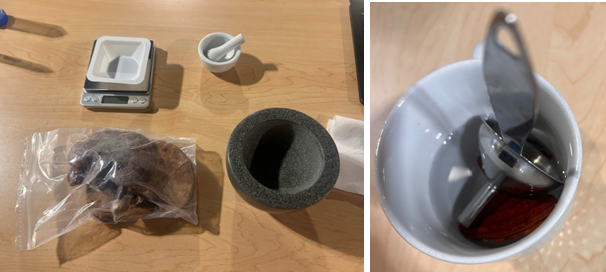
Figure 1: Set-up and preparations for Trial 1 (left) and visual of the soaking process (right)
The first disc diffusion test was conducted through dipping a sterile paper disc was soaked into the solution for 30 seconds. It was then left on a weight boat to dry and absorb the mixture for five minutes. While the disc was left to set, two petri dishes were spread with 100 𝜇L of treated E. coli using an L rod and a micropipette. Once the timer was up, the wafer was simply placed in the exact center of one of the two dishes, with the other acting as a control. The plates were labeled and then incubated for a week, until they were taken out and studied the following week.
A second trial was performed on March 10th, 2026, with the fungi sterilized using 70% rubbing alcohol and left to soak overnight for 12 hours (rather than removing and allowing the sample air to dry for several days). Once an extract was formed using the same steps as the first trial, the wafer paper disc, Disc A, was inoculated with 50𝜇L of the solution and immediately placed onto an agar plate spread with cultured Bacillus subtilis. Two more discs were placed in the same agar plate, roughly the same distances apart, with one, Disc B, being completely inoculated with ginger extract and the other, Disc C, being a combination of 25 𝜇L Reishi extract and 25 𝜇L ginger extract, which served to evaluate any combined effects between the two extracts. Two control discs spread with just the bacterial strains were also incubated. These steps were repeated with an E. coli plate, and both petri dishes were labelled, carefully secured, and placed in the incubator for three weeks.
Results
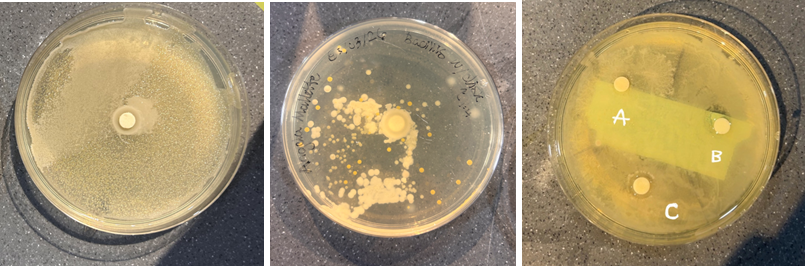
Figure 2: (left to right) Trial 1 – E. coli sample with pure Reishi solution soaked overnight; Trial 1 – Bacillus subtilis sample with pure Reishi solution soaked overnight; Trial 2 – E. coli sample with three discs: Disc A containing 50 𝜇L of Reishi solution soaked with 70% alcohol, Disc B containing 50 𝜇L of pure ginger extract, and Dish C containing a 1:1 ratio (25 𝜇L to 25 𝜇L) of both fungi and ginger extract.
For both trials followed through in this experiment, a zone of inhibition was expected to be seen at the very least. This was not the case for either pure mushroom extract samples. Regarding the second March 10th trial, the Bacillus subtilis plate containing all three discs experienced major sliding, indicating a user error and rendering the sample unusable for analysis. No such sliding occurred for the E. coli plate. However, the only clean zone of inhibition visible resulted from Disc B and Disc C, which both contained ginger extract, verifying its clear inhibitory effect on bacterial growth. This heavily opposes the data collected in Trial 1, which resulted in a thick ring of bacteria roughly 5mm in length from the edge of the disc’s radius.
For the Trial 2 pure Disc A, it is accurate to document that another circular ring was visible, but it was not as prominent as expected. This ring only turned out to be around 1mm in length from the edge of the disc’s radius. There was no clear evidence to confirm that the ring was bacterial. Regardless, the compromised results were likely due to either a compromised fungal sample or an external environmental factor. The evidence suggests that the material itself may have been contaminated, considering its unknown dehydration and packaging processes. Nevertheless, with the assistance of ImageJ, a closer examination of the Trial 2 plate demonstrated an 80% reduction of bacterial contamination in Disc A, a 44% increase in the size of the inhibition zone for Disc B, and a 16% decrease in the inhibition zone for Disc C.
Discussion
Due to the errors that severely impacted the entire outcome of this project, going forward, the next logical step would be to focus more on improved collection and sterilization of the Reishi without compromising its health properties. Additionally, other antibacterial species, rather than being dried and shipped by other organizations, can be extracted around a local area where results can be studied immediately.
Measures were taken to ensure that the extract remained as sanitary as possible, but with external factors like temperature and respiratory droplets, total purity can rarely be guaranteed. Additionally, typical sanitation processes, such as treating the fungi samples with elevated temperatures, could not be included as a possibility in the second trial, as there was a risk of damaging the proteins active within.
The trials that were conducted in this project mainly revolved around the effectiveness of one specific species against common bacterial strains. Testing and contrasting the disc diffusion results with other types of fungi would have been beneficial to understand where exactly the main error stemmed from.
References
Ayukekbong, J. A., Ntemgwa, M., & Atabe, A. N. (2017). The threat of antimicrobial resistance in developing countries: causes and control strategies. Antimicrobial Resistance & Infection Control, 6(1). https://doi.org/10.1186/s13756-017-0208-x
Del Giudice, P. (2020). Skin Infections Caused by Staphylococcus aureus. Acta Dermato Venereologica, 100(9), 0. https://doi.org/10.2340/00015555-3466
Md Faruque Ahmad, Alsayegh, A. A., Fakhruddin Ali Ahmad, Md Sayeed Akhtar, Alavudeen, S. S., Farkad Bantun, Wahab, S., Ahmed, A., Ali, M., Elbendary, E.
Y., Raposo, A., Nahla Kambal, & Abdelrahman, M. H. (2024). Ganoderma lucidum: Insight into antimicrobial and antioxidant properties with development of secondary metabolites. Heliyon, e25607–e25607. https://doi.org/10.1016/j.heliyon.2024.e25607
Raj, P. V., S A, D., Atif Ali, S., Hooi Kuan, T., Mathiyalagan, S., & Raman, S. (2015, January 7). Anti-proliferative Effect of Ganoderma Lucidum Polysaccharide and Triterpenoid Fractions against Cancer Cells. Manipal Journal of Pharmaceutical Sciences. https://impressions.manipal.edu/cgi/viewcontent.cgi?article=1010&context=mjp s
Ray, P., Singh, S., & Gupta, S. (2019). Topical Antimicrobial Therapy: Current Status and Challenges. Indian Journal of Medical Microbiology, 37(3), 299–308. https://doi.org/10.4103/ijmm.ijmm_19_443
Sharma, C., Bhardwaj, N., Sharma, A., Tuli, H. S., Batra, P., Beniwal, V., Gupta, G. K., & Sharma, A. K. (2019). Bioactive metabolites of Ganoderma lucidum: Factors, mechanism and broad-spectrum therapeutic potential. Journal of Herbal Medicine, 17-18, 100268. https://doi.org/10.1016/j.hermed.2019.100268
Sissi Wachtel-Galor, Yuen, J., Buswell, J. A., & Iris. (2011). Ganoderma lucidum (Lingzhi or Reishi). Nih.gov; CRC Press/Taylor & Francis. https://www.ncbi.nlm.nih.gov/books/NBK92757/
Thuy, Vo Linh Tu, Thu Minh Le, Tran Thanh Giang, Dao, Duong Hoang Loc, Hien, N., Nguyen Tuan Phat, Huynh, H.-H., Truyen, T., Nguyen, Q.-H., Do, U., Nguyen, D.,Truong Van Dat, & Huu, L. (2023). Pharmacological Activities and Safety of Ganoderma lucidum Spores: A Systematic Review. Cureus. https://doi.org/10.7759/cureus.44574
Yoon, S. Y., Seong Kug Eo, Kim, Y. S., Lee, C. K., & Han, S. S. (1994). Antimicrobial activity of Ganoderma lucidum extract alone and in combination with some antibiotics. Archives of Pharmacal Research, 17(6), 438–442. https://doi.org/10.1007/bf02979122