Keltie Mitchell – Life Science, Year 2
Abstract
Sea Star Wasting Syndrome has been a significant issue on our coast since its onset in 2013. Widely regarded as one of the largest singular marine die off events in recent history, it is of pressing importance to identify the causes and eradicate the triggers. Pisaster ochraceus was chosen as the subject of this study due to its colour polymorphism expressed as a result of its diet and metabolic pathways, and its frequency of observation. Research into differentiation of colour subtypes of P. ochraceus reveals conflicting data regarding their disease susceptibility and resilience. This project sought to clarify the existence of a link between colour expression and disease susceptibility, and as an extension, diet and disease. Using manual survey methods at three different sites selected based on primary food sources, the colour morphs of P. ochraceus were observed and the individuals inspected for disease. Results of these surveys yielded no disease data as the disease is less likely to be observed in the winter. The study instead pivoted to focus on the link between colour expression and diet. Results affirmed previous research in implying that there is indeed a connection between diet and colour expression.
Introduction
It is common knowledge among BC inhabitants that the local intertidal environment boasts incredible biodiversity and abundance. All these organisms are in balance with one another and strategic predation maintains this vital ecosystem (Harley et al., 2006). A notable species present within many of these ecosystems is Pisaster ochraceus, the ochre sea star. It is considered a keystone species, a species of particular importance to its ecosystem, due to its predation of small bivalves such as mussels, snails, oysters, and clams (Menge et al.,2016). When it predates these competing animals, it helps keep the ecosystem healthy and balanced through regulating species richness and enhancing diversity (Harley et al., 2006).
Often seen by intertidal observers, P. ochraceus is regarded as a highly common species. It can be seen in a dazzling variety of purple, orange, pink, and brown shades, though each site often has little colour variation. Mytilus californianus, the California mussel, is the primary food source for P. ochraceus when they are available (Harley et al., 2006). Two carotenoid pigments, mytiloxanthin and astaxanthin are responsible for producing the orange colour in P. ochraceus. Mytiloxanthin is derived from the mussel M. californianus and can be expressed when the sea star has absorbed it from its meal (Harley et al., 2006). Astaxanthin results from many natural metabolic pathways and levels of this can vary throughout the life of P. ochraceus (Harley et al., 2006). However, more research is needed to confirm this relationship, as well as determine which specific ecological factors contribute most to colour expression.
Another prey of P. ochraceus is Crassostrea gigas, the Pacific Oyster. It is an invasive species originally from eastern Asia, but through range extensions primarily caused by global climate change and human relocation, it can now be found in northern Europe and along the Pacific coast of North America as was found in a study by King et al., (2020). This species often forms very large reefs and displaces the fragile native species, significantly changing the ecosystem. Because of its popularity as in the culinary industry, C. gigas has been introduced in several locations worldwide and is now regarded as the world’s most globalized bivalve (King et al., 2020). It is predicted that the oyster’s adaptability will aid it in surviving and thriving through slow heat increases driven by climate change, as it has a high tolerance for environmental changes (Beck et al., 2024). A study in Puget Sound conducted by Beck et al (2024) highlights how rising ocean temperatures will increase larval recruitment of this bivalve. If this is the case, the local marine environments will transition to an oyster-based ecosystem, displacing less adaptable native species.
As local environments are changing, other new challenges are arising for the sea stars. Sea Star Wasting Syndrome (SSWS) is a disease affecting at least 20 asteroid (sea star) species, beginning with lesions on the rays and leading to the rapid deterioration of the organism (Work et al. 2021). This mass mortality event began in California during the spring of 2013 and quickly spread north to the rest of the coast up to Alaska (Hewson et al., 2014). This has affected many local sea star species, with especially devastating loss in the species Pycnopodia helainthoides, the sunflower sea star, which plays an integral role in maintaining the balance in kelp forests (Delaney, 2023). Sea stars play an important role in maintaining the health of kelp forests, which are epicenters of oxygen production; it is critical for us to learn more about potential causes of this disease (Delaney, 2023).
Many studies correlate SSWS with populations of Sea Star Associated Densoviruses (SSaDVs), but several environmental factors are still under investigation (Hewson et al., 2014). Due to observations of SSaDVs on healthy sea stars, many researchers are hesitant to accept the cause to be viruses. Some suggest causes including water temperature, meteorological conditions, and pCO₂ levels (Work et al., 2021). Research regarding the molecular and cellular pathology of the disease though there has yielded highly contradictory results, as a diverse variety of potential causes have been identified (Work et al., 2021; Hewson et al,. 2018; Menge et al., 2016). Studies are ongoing and will investigate many different potential sources in several different species.
P. ochraceus has experienced some population loss as a result of SSWS but due to its natural abundance, it has remained a frequent sight at local beaches, exhibiting its distinctive polychromatism. Though the orange and purple variants of P. ochraceus often live in proximity and share most visible traits, more research is being done into their differences (Harley at al., 2006). Past research by Work et al (2021) concluded that orange sea stars developed more severe lesions than their purple counterparts but surprisingly were able to survive longer in deteriorating condition. While this and similar studies were conducted on captive individuals, the few field studies have confirmed similar results (Menge et al., 2016). Orange individuals are being affected more acutely even though they comprise less than 20% of the total population at the study site in Oregon (Menge et al., 2016). More field studies are needed to determine whether these results are due to the fragility of sea stars in captivity or occurring regularly in the local ecosystems. As the habitat of P. ochraceus changes, the diet of the sea stars will adapt as well. If these results can be observed in local ecosystems, research should be done into potential correlations with the changing climate and SSWS.
The few field studies regarding the colour phenotypes of P. ochraceus have been conducted in southern coastal locations such as Oregon and California focusing on the link between colour expression and frequency of observed disease (Menge et al., 2016; Harley et al., 2006). Because these areas have different ocean conditions and prey items, the colours may differ and so may the rates of disease. Studies inspecting the direct link between availability of various prey and disease rates can aid in efforts to project future populations and ecosystem health. More studies should be conducted on the BC coast to help predict the impact of a transition to oyster-based ecosystems. This is important in guiding efforts to maintain local ecosystems and the biodiversity within. This study seeks to explore potential differences between rates of SSWS in oyster-based, mussel-based, and mixed sites in BC while also reinforcing past research correlating abundance of colour morphs with primary prey types.
Materials and Methods
In order to select a site with adequate proportions of mussels and oysters, searches on iNaturalist were used comparing populations of target species with local sea star numbers. Three varied sites were selected based on their ease of access and potential for sea star abundance. One site was selected composed primarily of oysters, one of mussels, and one that had a mix of prey food options, including both oysters and mussels in approximately equal proportions. Surveys were conducted on low tides of less than one meter in the low intertidal zone.
Due to the varied terrain of the intertidal sites surveyed, no fixed measurement could properly represent the density of the sea star population. Survey measurements of between three by three and five by five metres were established with a tape measure upon inspection of the site and often included prominent rock features where sea stars cluster. The densest area of sea stars was selected from each site for surveying as it would provide the most representation of the specific colour morphs present. Counts were conducted in lines up and down the isolated area, all sea stars were counted, inspected for SSWS, and their colour noted. P. ochraceus colour was sorted into two groups: purple and orange. The “purple” category included the typical medium purple as well as other dark shades of red and pink, and the “orange” category contained all orange sea stars as the colour varies minimally by site.
At the nearest ocean access point to the survey area, three abiotic factors were measured with the Vernier LabQuest 3 tool. Dissolved oxygen, temperature, and pH were monitored for three minutes to ensure stabilization in measurement. Other observations deemed relevant when at site such as weather, air temperature, proximity to areas of significant runoff, pollution sources, and overall species abundance were noted to provide greater context for the data. Duplicate surveys were repeated for two of the three sites to reaffirm population patterns.
Results
Through a series of five intertidal surveys, conducted at three different beach sites, a baseline of data was observed. The greatest total abundance of P. ochraceus was noted at the mussel survey site, and the least was at the mixed site in which both surveys yielded less than 10 specimens. In all surveys, purple organisms greatly outnumbered their orange counterparts, apart from the mussel-based site in which there were only seven more purple than orange (Figure 1).
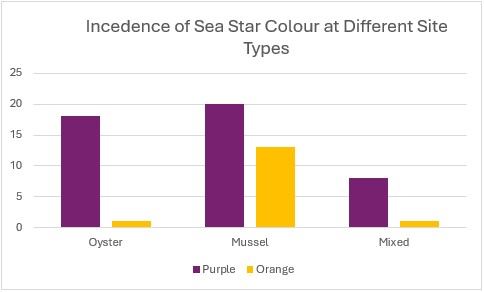
Figure 1: Mean sea star counts at the oyster-based, mussel-based, and mixed sites.
The abiotic factors pH, temperature, and dissolved oxygen were measured at each site, except for one survey of the mixed beach when the Vernier tool ran out of battery (Table 1).
Table 1: Comparison of the mean pH, dissolved oxygen, and temperature with the counts of purple and orange sea stars observed.

Discussion
The primary difficulty in executing this project was the seasonality of Sea Star Wasting Syndrome (SSWS). No SSWS was observed at any site during these surveys, most likely due to the cold temperatures of winter. Though there is conflicting research on whether SSWS is more prevalent in the winter or summer (Bates et al., 2009), no disease was observed in the surveyed sites, but iNaturalist observations from previous summers confirm its presence. The total lack of disease data prevents the validation or rejection of any hypothesis. This study can instead be used to add more evidence to previous research by Harley et al. (2006) regarding the correlation between diet and colour. Since many of these studies were conducted with captive individuals, these observations can reaffirm these patterns in the wild.
The research collected in these surveys reinforces research conducted by Harley et al. (2006), suggesting that there is indeed a correlation between the availability of the prey item M. californianus (the California Mussel) and the polychromatism of a given site. The increase in the orange sea stars observed at sites primarily mussel-based is most likely due to the increase of the orange pigment mytiloxanthin. However, more seasonally accurate information is needed in order to correlate the sea star diet with SSWS.
Expected results would have correlated greater numbers of C. gigas with a decreased incidence of orange sea stars and therefore less wasting disease. Other purposes of the study were to observe potential differences between wasting disease expression and intensity between colour morphs. The total lack of wasting disease observed did not allow for this insight to be drawn. However, the expected increase of orange sea stars with a greater concentration of M. californianus was observed.
The environmental data collected at each survey offered little help towards the validation of the hypothesis, as there were no significant trends expressed in this data. Similar conflicting results were observed by Menge et al., (2016). The measurements fluctuated minimally between sites; all averages of measurements varied less than one unit. This is potentially due to the number of measurements; more meaningful data could result if there were more surveys or duplicates over a longer study period.
Additional difficulty was experienced in the actual observation of the organisms. Sea stars seek protection from predators and environmental conditions by sheltering in small cracks and under rocks. Removing them for observation would tear their tube feet, injuring the organisms. Surveyors instead attempted to observe the sea stars in situ, to the best of their abilities. This counting method may have impeded the accuracy of the count results, as some sea stars were hidden by others or their qualities difficult to observe. The difficulties posed by surveying have led many researchers to conduct their research in the lab where more variables can be manipulated and specimens are easier to access.
Future research will require a longer study period over several seasons to establish clearer data. Only surveying during the winter limits the ability to observe significant SSWS in the environment. Repeating surveys will help isolate specific trends, as well as increasing the chances of documenting fully exposed specimens.
References
Bates, A.E., Hilton, B. J., Harley, C. D. G. (2009). Effects of temperature, season and locality on wasting disease in the keystone predatory sea star Pisaster ochraceus. Diseases of Aquatic Organisms.86. https://doi.org/10.3354/dao02125
Beck, E. L., Ruesink, J., Troyer, S., & Behrens, M. (2024). Wild populations of Pacific oysters (Magallana gigas) emerge during the blob heatwave in South Puget sound, Washington USA. Frontiers in Marine Science, 11. https://doi.org/10.3389/fmars.2024.1292062
Delaney, Shannon, M. (2023). Sunflower Sea Star (Pycnopodia helianthoides) 1834-2023 : Bibliography. National Ocean and Atmospheric Administration. https://doi.org/10.25923/22wm-b782
Harley, C. D. G., Pankey, M. S., Wares, J. P., Grosberg, R. K., & Wonham, M. J. (2006). Color Polymorphism and Genetic Structure in the Sea Star Pisaster ochraceus. The Biological Bulletin, 211(3), 248–262. https://doi.org/10.2307/4134547
Hewson, I., Button, J. B., Gudenkauf, B. M., Miner, B., Newton, A. L., Gaydos, J. K., Wynne, J., Groves, C. L., Hendler, G., Murray, M., Fradkin, S., Breitbart, M., Fahsbender, E., Lafferty, K. D., Kilpatrick, A. M., Miner, C. M., Raimondi, P., Lahner, L., Friedman, C. S., … Harvell, C. D. (2014). Densovirus associated with sea-star wasting disease and mass mortality. Proceedings of the National Academy of Sciences, 111(48), 17278–17283. https://doi.org/10.1073/pnas.1416625111
King, N. G., Wilmes, S. B., Smyth, D., Tinker, J., Robins, P. E., Thorpe, J., Jones, L., & Malham, S. K. (2020). Climate change accelerates range expansion of the invasive non-native species, the Pacific oyster, Crassostrea gigas. ICES Journal of Marine Science, 78(1), 70–81. https://doi.org/10.1093/icesjms/fsaa189
Menge, B. A., Cerny-Chipman, E. B., Johnson, A., Sullivan, J., Gravem, S., & Chan, F. (2016). Correction: Sea Star Wasting Disease in the Keystone Predator Pisaster ochraceus in Oregon: Insights into Differential Population Impacts, Recovery, Predation Rate, and Temperature Effects from Long-Term Research. PLOS ONE, 11(6), e0157302. https://doi.org/10.1371/journal.pone.0157302
Work, T. M., Weatherby, T. M., DeRito, C. M., Besemer, R. M., & Hewson, I. (2021). Sea star wasting disease pathology in Pisaster ochraceus shows a basal-to-surface process affecting color phenotypes differently. Diseases of Aquatic Organisms, 145, 21–33. https://doi.org/10.3354/dao03598