Frank Cao – Life Science
Abstract
This research investigates the effectiveness of neem oil and baking soda in controlling anthracnose infection in spinach. The study presents a detailed methodology and analyzes the results to understand the efficacy of these natural compounds in managing anthracnose, contributing to sustainable agricultural practices. This study can be used as a test to observe the potential applications of the neem oil and baking soda in the anthracnose infection control among the spinach.
Introduction
Anthracnose, caused by Colletotrichum species, poses a global risk to crop growth and yield (Pwakem, 2015). Traditionally, anthracnose management has relied on synthetic fungicides and cultural practices such as crop rotation and sanitation (Singh et al., 2019). However, recent agricultural research highlights the growing interest in botanicals as alternatives for anthracnose management, including neem oil and plant extracts (Niaz et al., 2008). Despite these advancements, there remains a significant gap in understanding the application of neem oil and baking soda for anthracnose control in spinach. This study aims to address this gap by evaluating the efficacy of neem oil and baking soda, thereby bridging theory with practical strategies for effective and sustainable anthracnose management in spinach.
Materials and Methods
In the procedure, the environmental conditions of the planting space were maintained within a specific range, with temperatures consistently between 50 to 60 degrees F. 32 sets of pots were prepared to cultivate spinach seeds. The growth process involved constant watering and fertilization, each plant was regularly irrigated with a nutrient mixture (∼10ml) every three days, which contains nitrogen, phosphorus and other elements that are beneficial to the growth of spinach leaves. Approximately two weeks after seed planting, the spinach plants reached a stage with two layers of edible leaves, four on each layer. Four sets were designated as a control group (Group A).
To induce anthracnose infection, leaves from affected plants (tomatoes, maple, and roses) were cut into pieces and spread directly onto the leaves of the remaining 28 pots. Throughout this process, the temperature was deliberately maintained 3-5°F or between 63 – 65°F higher than the normal range with increased humidity to facilitate infection progression. This anthracnose spreading procedure was repeated until signs of anthracnose infection were observed on the leaves.
The subsequent steps involved the application of different treatments to assess their impact on the plant (Table 1). Group B received a solution of dissolved baking soda (30 grams per liter) to the leaves of four pots. Group C received neem oil (1%) applied to the leaves of another four pots. Group D, serving as a comparison group, consisted of the remaining four pots with no treatment and only anthracnose-infected leaves.
Table 1: Treatment groups
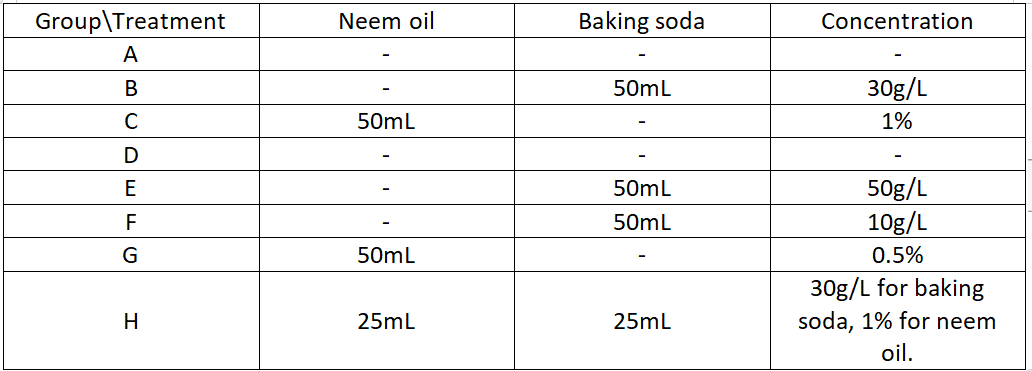
Further variations were introduced in the treatment groups. Group E had a higher concentration of baking soda solution (50 grams per liter) applied to their leaves within included four pots. Groups F and G received a lower concentration of baking soda solution (10 grams per liter) and neem oil solution (0.5%), respectively, on another four pots each. Group H was treated with a combination of neem oil (25 mL, 1%) and baking soda solution (25 mL at 30 grams per liter) applied to their leaves in another four pots each.
To measure the recovery rate of different treatment, the formula is:

The “amount of leaves recovered” and the “total amount of leaves infected” are all collected in the same group, with same treatments.
These carefully designed treatments aim to evaluate the efficacy of different concentrations of baking soda and neem oil in controlling anthracnose infection in spinach, with specific attention to variations in concentration and formulation.
Results
Upon the completion of the experimental period, observations were made on the growth and infection progression of spinach plants across the different treatment groups (Figure 1).
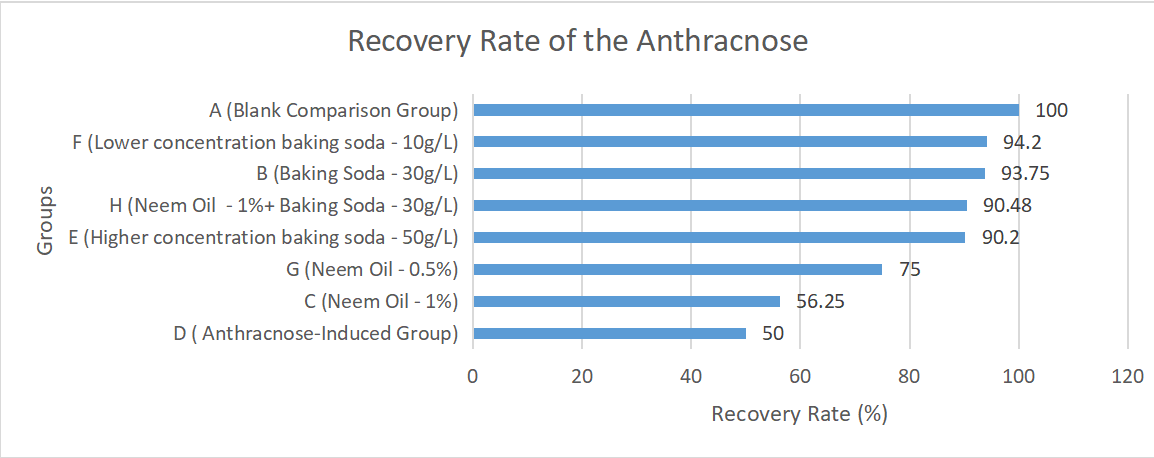
Figure 1: Recovery rate of anthracnose
1. Growth and Infection Progression
1.1 No treatment Group (Group A):
The four sets designated as a blank comparison group exhibited typical spinach growth with no intentional anthracnose infection. This group serves as a baseline for assessing the impact of anthracnose induction on subsequent treatment groups.
1.2 Anthracnose-Induced Group (Group D):
The deliberate induction of anthracnose resulted in characteristic symptoms of infections on spinach leaves. The infection progression was monitored until a noticeable manifestation of anthracnose was observed.
2. Treatment Groups
2.1 Baking Soda Treatment Groups (Groups B, E, F):
Group B (Baking Soda – 30g/L) demonstrated a recovery rate of 93.75%, indicating substantial effectiveness in controlling anthracnose. Group E (Higher concentration baking soda – 50g/L) showed a recovery rate of 90.0%. Group F (Lower concentration baking soda – 10g/L) showed a recovery rate of 94.2%.
2.2 Neem Oil Treatment Groups (Groups C, G, H):
Group C (Neem Oil – 1%) exhibited a recovery rate of 56.25%, indicating a moderate efficacy in anthracnose control. Group G (Neem Oil – 0.5%) showed a recovery rate of 75.00%, suggesting higher efficacy compared to neem oil alone. Group H (Neem Oil + Baking Soda) displayed a recovery rate of 90.48%.
Discussion
The recovery rates observed in the different treatment groups offer valuable insights into the efficacy of baking soda and neem oil in controlling anthracnose in spinach. Consistent with previous studies (Singh et al., 2019), the higher recovery rate in Group B (Baking Soda – 30g/L) compared to the higher concentration (Group D – Baking Soda – 50g/L) implies an optimal concentration for baking soda’s effectiveness. Moreover, the interactive effect observed in Group H (Neem Oil + Baking Soda) aligns with findings by Chi and Vu (2019), highlighting the potential benefits of combining these agents for enhanced disease control. These results reinforce the notion that a carefully calibrated combination of natural compounds could serve as an effective alternative to synthetic fungicides (Gahukar, 2014). However, several limitations should be considered. The experiment was conducted under controlled conditions, similar to previous research (Uysal and Kurt, 2017), and real-world variability in environmental factors may impact the results differently. While my study focused on specific concentrations of different treatments, similar to those examined by Niaz et al. (2008), further exploration of optimal dosages and application frequencies is warranted. Additionally, the short-term nature of the experiment may not fully capture the long-term effects of the treatments, as noted by Pwakem (2015). Future research could address these limitations by conducting field trials, exploring a broader range of concentrations, and extending the observation period to assess the sustained impact of the treatments, as suggested by previous studies (Chi and Vu, 2019; Singh et al., 2019). Furthermore, investigating alternative treatments for this pathogen, such as microbial biocontrol agents or cultural practices like crop rotation, could provide comprehensive insights into anthracnose management strategies.
Conclusion
In conclusion, this study provides valuable insights into the effective management of anthracnose in spinach through the application of baking soda and neem oil. The results, supported by analysis, depict the significance of optimal concentrations and the potential effects of combining natural compounds. These findings contribute to the growing body of knowledge in sustainable agriculture and offer practical implications for farmers seeking sustainable disease management strategies. Moving forward, further research avenues could delve into refining our understanding by investigating additional variables, such as the influence of application methods and timing, while also considering the environmental impact. Furthermore, conducting field trials under diverse environmental conditions would provide a more comprehensive understanding of these interventions’ effectiveness in real-world settings.
References
Chi, K. J., & Anh, V T. T. (2019). “Effect of apple cider vinegar, baking soda and salt on growth of Colletotrichum musae and development of anthracnose disease on banana fruits.” International Journal of Postharvest Technology and Innovation 6(4), 239-256.
Gahukar, R. T. (2014) “Factors affecting content and bioefficacy of neem (Azadirachta indica A. Juss.) phytochemicals used in agricultural pest control: a review.” Crop Protection, 62, 93-99.
Niaz I., Sitara U., Kazmi, S. A. R., and Qadri, S. (2008) “Comparison of antifungal properties of neem seed oil collected from different parts of Pakistan.” Pakistan Journal of Botany, 40(1), 403.
Pwakem, D.B. (2015) “Evaluation of botanicals for the control of anthracnose (Colletotrichum gloeosporioides Penz) of yam (Dioscorea rotundata Poir).” (Doctoral dissertation).
Singh, J., Bhatnagar, S. K. & Tomar, A. (2019) “Study on fungicidal effect of plant extracts on plant pathogenic fungi and the economy of extract preparation and efficacy in comparison to synthetic/chemical fungicides.” Journal of Applied and Natural Science 11(2), 333-337.
Uysal, A., & Kurt, S. (2017) “Influence of inoculum density, temperature, wetness duration, and leaf age on infection and development of spinach anthracnose caused by the fungal pathogen Colletotrichum spinaciae.” European Journal of Plant Pathology, 149, 1041-1052.