Esther Jushin Kim – Applied Science
Abstract
Circadian rhythm is proven to have an impact on an organism’s strength. Further research on the optimal light exposure plants should receive could help any farmers–whether it be for a personal garden or commercial farming. This experiment has demonstrated the effects of different light exposures on plants on a smaller scale. The results showed that plants grow best when they are exposed to light in consistent intervals. This experiment hopes to set a basis for future experiments manipulating more plant growth conditions to find the most favourable condition.
Introduction
Circadian rhythm has a prominent role in maintaining people’s healthy lives (Farhud et al. 2018). Factors that make up circadian rhythm are mainly “light, night and day duration, seasons, and lifestyle” (Farhud et al. 2018). Therefore, if circadian rhythm is essential for people, it is important to research if it has the same importance for plants, which are also living organisms. The circadian rhythm is “an internal regulator in cells of organisms, coordinates physiological and behavioural activities with daily environmental variations within 24 h cycles” (Farhud et al. 2018). While this process ensures that regular human body functions are performing to par, it can also affect some serious parts of our body such as cancerous cells. Undergoing an abnormal number of divisions is caused by a disruption of circadian rhythms. A well-balanced circadian rhythm is essential for organism health (Farhud et al. 2018).
A plant’s metabolism of sucrose to source growth–is reliant on environmental changes in light quantity and quality (Kim et al. 2017). There is more creation of sucrose and starch during the daytime, whilst at nighttime the process is limited (Kim et al. 2017). The starch polymers in plants are used to store glucose in photosynthesis (Sherrell 2022). Continuous creation of their energy source during inactive times, like night, is inefficient for the organism. For organisms such as plants who do not move and heavily rely on their ability to be efficient to survive, controlling the creation and use of energy is important.
Therefore, it is important to determine the best environment for a plant to grow efficiently. Under changing climates with pollution creating a more negative impact on climate health, and specifically crop health, it is important that humans are able to understand how to best grow nutritionally rich plants in alternative environments with specific consideration given to light exposure quantities i.e. timing and duration. For example, while some crops are still grown outdoors, farmers opt for greenhouse farming to grow and sell crops not during their seasonal time. Improper management of the light exposure could result in lower quality of crop plants. This study will test if light exposure and changes to circadian rhythm influences the quality and growth rate of plants, so that in the future it may be further applied into the industrial farming world. So, would manipulating light exposure in a controlled environment affect the health and quality of plants?
Materials and Methods
A well-ventilated black plastic box was set up and divided into three sections to create three different light exposure environments: 1-inconsistent lighting, 2-constant lighting and 3-day/night lighting. Holes were drilled on the bottom of the box to ensure ventilation but not have effect on light exposure. See Figure 1 to see the holes drilled in the box. In each section, six 2.5inch diameter pots were placed. See Figure 2 outlining the pots placements in the box.

Figure 1. Ventilation of box lid

Figure 2. Pot placement
The planting process involved adding 55.00g of Miracle-Gro Potting Mix into each pot. 5 seeds of West Coast Seeds Microgreens – Rad Radish (MG111) were then placed into each pot. Briignite grow light bulbs with Fosmon timer switches were set up and drilled into the lid of the box. The timer switches were programmed for each of the box sections. For group 1-inconsistent lighting, the ‘on’ and ‘off’ was set for every 2-hours. Group 2-constant lighting did not require a Fosmon timer switch because there was constant lighting. Lastly for group 3-day/night lighting, the timer was set ‘on’ for 12 hours and ‘off’ for 12 hours. A spray bottle was filled up to the 10 fl oz line. The plants were watered twice a week. Plants were measured with a ruler one week after planting on March 6, 2024, and again two weeks after planting on March 13, 2024. In some pots, more than one seed successfully sprouted so a height for each individual sprout was measured and recorded. An average for each group was calculated every measuring day.
Results
Results showed that the group with day/night lighting had the most growth. The day/night lighting consisted of the light on from 6am to 6pm and off during the rest of the day. This group replicated the environment where it is dark at night and light during the day. Hence, it proves that plant growth is affected by circadian rhythm and that the sequence of exposure to light (inconsistent, constant or in 12 hour intervals) affects growth.
The day/night lighting group’s individual sprouts were also observed to have grown more upright and straight than in the other groups. Consistent lighting group sprouts were observed to be less straight, weaker and darker in colour, not as bright green as the day/night lighting group. Therefore, this demonstrates that plants’ health and quality is also affected by circadian rhythm.
The group with consistent lighting, where the light never turns off, had the least amount of growth. The inconsistent light group had more growth than the consistent lighting group, but less growth compared to the day/night lighting group. The day/night lighting group’s average plant height was roughly 2 times larger than that of the inconsistent lighting group.
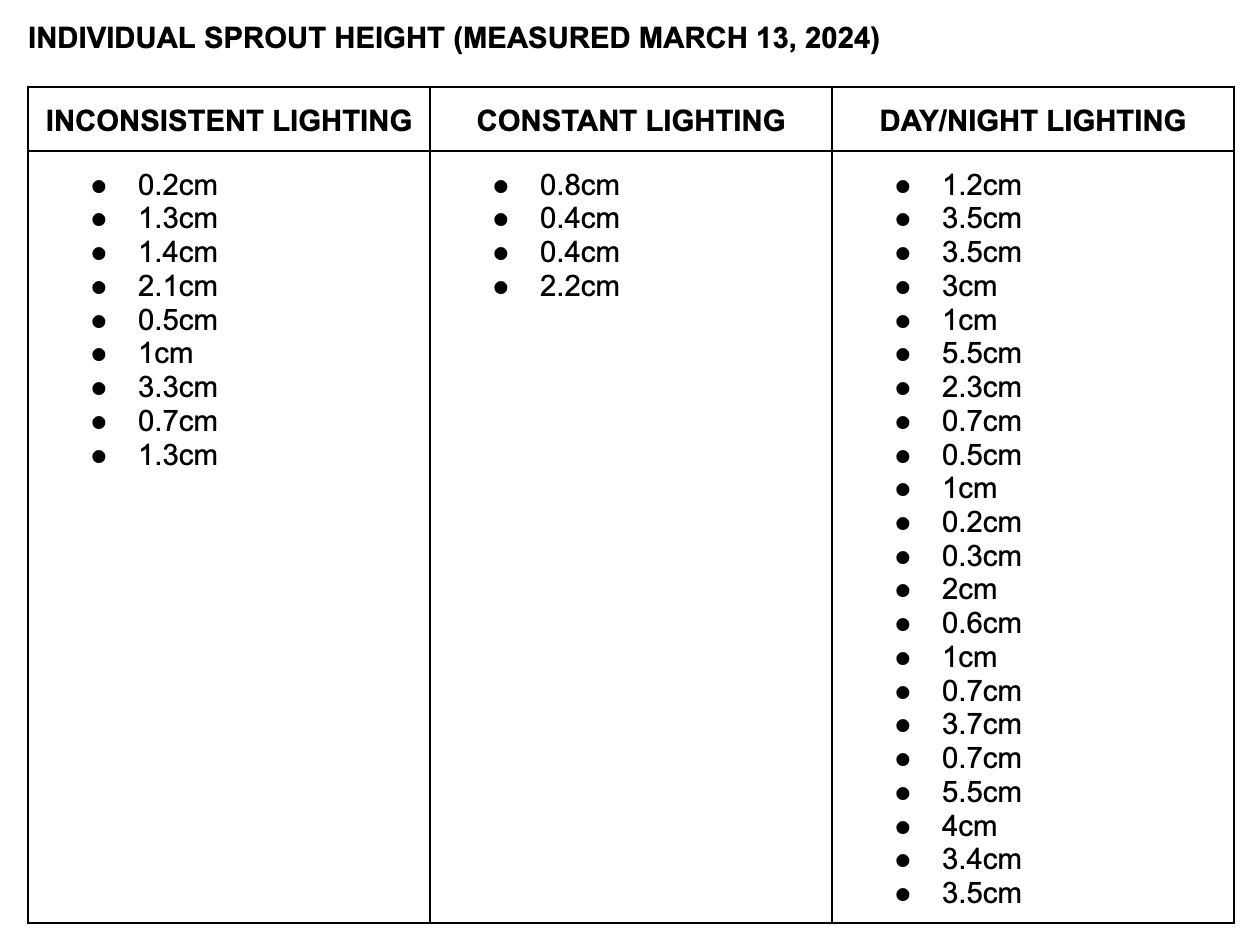
Figure 3 – Data of individual sprout height measured
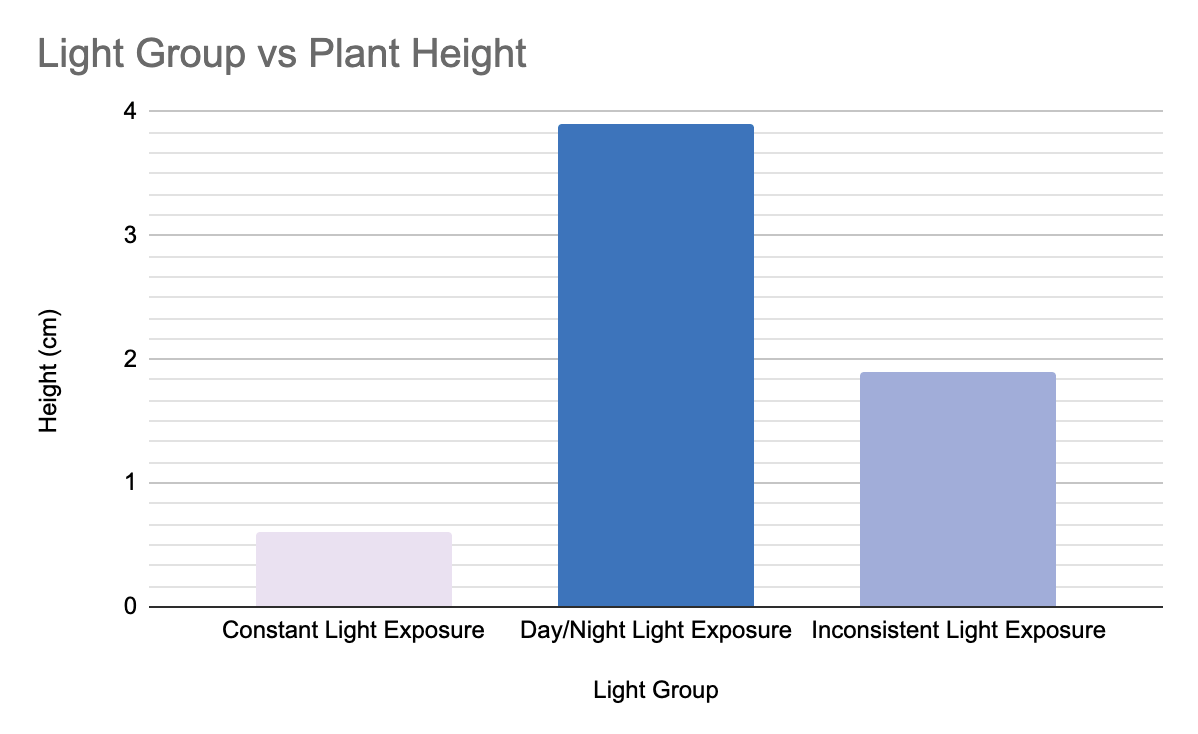
Figure 4 – Results of light group and plant height
Discussion
The results of this experiment may be influenced by a few limitations in the set-up of the experiment. The consistent lighting group, where there is constant light in a small container may have caused the water to evaporate more often which may have resulted in the plants drying out faster. Hence, it may not have had enough water compared to the inconsistent and day/night lighting groups. Due to space restrictions, a total of 18 plants, six in each of the three sections were grown. As it was a small sample size, it limits the ability for the results to be generalised. However, this experiment could act as a basis for large-scaled experiments in the future.
There was a limited duration of the experiment of 2 weeks. While it measures short-term growth, results may vary in long-term growth. With the limited time, a quick-growing plant, pea plants, were grown. Therefore this experiment is pea plant specific, but it could be replicated for other plants. It is important to recognise results may vary for different species.
Conclusion
Results of this study which proves circadian rhythm is essential for good plant quality and effective growth can be further developed to inform industrial-farming methods. To overcome climate change and be able to still maintain high-quality crop growth, taking into consideration the circadian rhythm and light exposure is crucial.
References
Farhud, D., & Aryan, Z. (2018, August). Circadian rhythm, lifestyle and Health: A Narrative Review. Iranian journal of public health. https://www.ncbi.nlm.nih.gov/pmc/articles/PMC6123576/
Kim, J. A., Kim, H.-S., Choi, S.-H., Jang, J.-Y., Jeong, M.-J., & Lee, S. I. (2017, December 11). The importance of the circadian clock in regulating plant metabolism. International journal of molecular sciences. https://www.ncbi.nlm.nih.gov/pmc/articles/PMC5751282/#:~:text=Plants%20respond%20to%20environmental%20changes,production%20and%20consumption%20of%20energy
Okamoto-Mizuno, K., & Mizuno, K. (2012, May 31). Effects of thermal environment on sleep and circadian rhythm – journal of physiological anthropology. BioMed Central. https://jphysiolanthropol.biomedcentral.com/articles/10.1186/1880-6805-31-14
Sherrell, Zia (2022, Jan 19) What to know about starch Medical News Today https://www.medicalnewstoday.com/articles/what-is-starch
Soares, J. C., Santos, C. S., Carvalho, S. M. P., Pintado, M. M., & Vasconcelos, M. W. (2019, August 2). Preserving the nutritional quality of crop plants under a changing climate: Importance and strategies – plant and Soil. SpringerLink. https://link.springer.com/article/10.1007/s11104-019-04229-0
Venkat, A., & Muneer, S. (2022, February 23). Role of circadian rhythms in major plant metabolic and signalling pathways. Frontiers. https://www.frontiersin.org/articles/10.3389/fpls.2022.836244/full